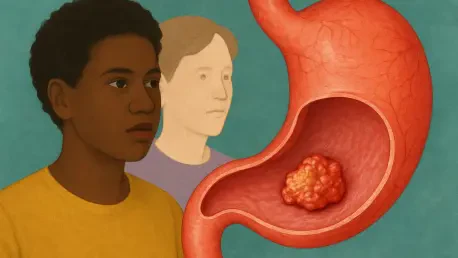

A comprehensive global analysis has uncovered a troubling paradox in the fight against early-onset gastric cancer, a form of the disease striking individuals under the age of 50. While worldwide mortality rates have been steadily decreasing for decades, this positive trend masks a deepening and dangerous divide, with high-income nations making significant progress while many low-income regions are falling further behind. The landmark research, which meticulously maps the incidence, mortality, and risk factors across 204 countries and territories from 1990 to 2021, provides the first complete picture of this complex global health challenge. The findings underscore a stark reality: the burden of this aggressive cancer is increasingly shifting to the world’s most vulnerable populations, demanding an urgent re-evaluation of public health strategies to prevent a crisis of inequality.
A Unique Disease with a Heavy Toll
Early-onset gastric cancer (EOGC) presents a distinct clinical challenge that separates it from the disease typically seen in older populations. This form of cancer is often characterized by more aggressive biological patterns, including a higher prevalence of diffuse histologic features and signet ring cell predominance. These characteristics are associated with rapid tumor growth and a consequently poorer prognosis, making early detection and treatment even more critical. The onset of this disease during an individual’s most productive years amplifies its societal and economic impact, disrupting careers, families, and communities. While established environmental and lifestyle contributors such as Helicobacter pylori infection, smoking, and high-sodium diets are known risk factors, a comprehensive global examination of their specific role in EOGC was previously lacking. This new research directly addresses this knowledge gap, offering an in-depth analysis of the disease’s distribution and drivers to inform the development of more effective and targeted prevention strategies worldwide.
The study’s analysis of global data painted a stark picture of the disease’s substantial burden. In the year 2021 alone, there were approximately 125,000 new cases, 78,000 deaths, and an astonishing 3.86 million disability-adjusted life years (DALYs) attributed to EOGC. A DALY represents one lost year of “healthy” life, a metric that powerfully illustrates the profound impact of the disease not only on longevity but also on the quality of life for patients and their families. Despite these significant figures, the research also identified a positive overarching trend in the three decades leading up to 2021. During this period, the world experienced a steady decline in the overall burden of EOGC, with the global mortality rate decreasing at an impressive average annual rate of 2.9%. This progress was most pronounced in high-income regions, particularly in East Asia and parts of Europe, where concerted public health efforts, improved screening methods, and beneficial lifestyle changes have likely played a pivotal role in this success.
A Tale of Two Worlds in Cancer Control
The global average decline in early-onset gastric cancer conceals a more troubling regional reality, revealing a growing chasm in global cancer control. In stark contrast to the progress observed in wealthier nations, several countries in sub-Saharan Africa experienced rising incidence and mortality rates, signaling an urgent need for increased attention and resources in these areas. Projections from the study’s modeling suggest that while the overall global decline is expected to continue through the year 2040, the underlying inequalities are likely to persist or even worsen without targeted action. The research also provided a granular look at demographic patterns, finding that the incidence of the disease peaked in the 45-49 age group, underscoring its impact on the late-middle-aged workforce. A notable sex-based disparity was also observed: while males showed a higher overall prevalence, females under the age of 30 exhibited a greater mortality risk, a counterintuitive finding that warrants further investigation to understand the underlying biological or social factors at play.
A central finding of the research was the definitive identification of smoking and high-salt diets as the two leading modifiable risk factors for EOGC, which together are responsible for a substantial portion of the disease burden. High-salt diets were identified as the primary contributor, accounting for 7.7% of all EOGC-related DALYs, while smoking was a close second, responsible for 7.1% of DALYs. The study strongly correlated these risk factors and their outcomes with socioeconomic development. High-income regions have successfully leveraged their resources to achieve steady reductions in the EOGC burden through robust public health campaigns, widespread health education, and the implementation of early screening programs like endoscopy. Conversely, low-income regions face a growing burden compounded by limited access to healthcare, insufficient public health infrastructure, and the pressures of rapid population growth. This disparity means that while wealthier nations are making tangible progress, poorer nations are falling further behind, creating a deepening global health inequity.
Charting a Path Forward with Targeted Strategies
The authors of the study emphasized that the findings served as a clear and urgent call to action for the global health community. The research demonstrated that proven preventive measures—specifically smoking control, dietary salt reduction, and the eradication of H. pylori—could significantly lower the global burden of EOGC. However, the data also made it abundantly clear that a one-size-fits-all approach would be insufficient to address the widening disparities. The study argued for the necessity of tailoring these strategies to local conditions, available resources, and specific cultural contexts to achieve meaningful results. For high-risk and high-income regions like East Asia, the focus should be on intensifying existing efforts, which includes promoting dietary interventions aimed at reducing salt intake and expanding access to early endoscopic screening for at-risk populations. For low-resource settings, the priorities were more foundational, requiring critical first steps such as strengthening the healthcare infrastructure, expanding access to basic diagnostic and treatment services, and launching public awareness programs to educate communities about risk factors and early symptoms.
To support these on-the-ground efforts, the study advocated for broader public health policies at the governmental level. It was suggested that governments could implement measures such as increased tobacco taxation to discourage smoking, clear and mandatory food labeling to help consumers make healthier dietary choices, and national salt reduction campaigns to shift population-wide consumption habits. Looking ahead, the researchers proposed that future progress would ultimately depend on the successful integration of epidemiological data with emerging genomic and environmental monitoring technologies. This integrated approach would allow for the more precise identification of susceptible populations and the development of highly targeted precision prevention strategies. Such a forward-thinking framework was presented as the most effective path to not only continue the global decline in EOGC but also to finally close the unacceptable and growing gap in outcomes between the world’s richest and poorest nations.