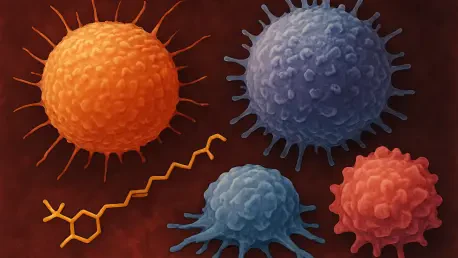

New research from Princeton University’s Ludwig Institute for Cancer Research has untangled the complex and often harmful relationship between a vitamin A derivative and the body’s ability to fight cancer, resolving a long-standing paradox about vitamin A’s role in oncology and introducing a groundbreaking class of potential drugs. This comprehensive body of work, detailed across two significant publications, not only clarifies the mechanisms by which all-trans retinoic acid (RA) compromises the body’s natural anti-tumor defenses but also demonstrates how it sabotages advanced immunotherapies. The findings culminate in the development of a novel class of candidate drugs designed to dismantle this immunosuppressive shield, paving the way for a new therapeutic strategy. This research provides a definitive explanation for RA’s detrimental effects, showing how it undermines both innate immunity and the efficacy of treatments like dendritic cell cancer vaccines.
The Dendritic Cell Dilemma
A Vaccine’s Hidden Flaw
Dendritic cells, or DCs, function as the sentinels of the adaptive immune system, patrolling the body for foreign invaders and signs of disease, including cancer. When they detect disease-associated proteins, known as antigens, they process these fragments and present them to T cells, which are the immune system’s primary soldiers. This process activates a highly specific and potent immune assault against the malignant cells. The entire concept of DC-based cancer vaccines is built on harnessing this natural mechanism. The therapy involves isolating a patient’s immature immune cells, cultivating them into mature DCs in a laboratory setting while exposing them to antigens from the patient’s own tumor, and then reinfusing these primed and educated DCs back into the body. The goal is to elicit a powerful, tailored anti-cancer response that the patient’s immune system was previously unable to mount on its own, representing a pinnacle of personalized medicine.
Despite the elegant logic and immense promise of this approach, DC-based vaccines have consistently underperformed in clinical trials, leaving researchers searching for an explanation. The team at Ludwig Princeton has now identified a critical, previously unknown reason for this widespread failure. They discovered that the standard laboratory conditions used to differentiate and culture the patient’s cells into DCs inadvertently trigger the expression of a specific enzyme called ALD#a2. This enzyme is directly responsible for synthesizing high levels of retinoic acid within the dendritic cells themselves. This internally produced RA activates a nuclear signaling pathway that has a profoundly negative effect on the vaccine’s intended function. It actively suppresses the maturation of the dendritic cells, significantly diminishing their capacity to effectively prime T cells and orchestrate a robust anti-tumor attack. The study also revealed that RA secreted by these compromised DCs alters the surrounding immune environment, favoring the development of macrophages that are far less efficient at combating cancer, further undermining the therapy’s potential.
A Pharmacological Solution
To counteract this self-sabotaging mechanism inherent in the vaccine preparation process, the research team embarked on designing a novel pharmacological intervention. The result of this effort is a candidate drug named KyA33, a compound specifically engineered to act as a potent inhibitor of the ALD#a2 enzyme. Its mechanism is precise: by blocking ALD#a2, it effectively shuts down the production of retinoic acid within the dendritic cells as they are being cultured in the laboratory. This intervention is designed to be applied during the ex vivo phase of vaccine creation, ensuring that the DCs are not compromised before they are reintroduced into the patient. The development of KyA33 represents a significant step forward, targeting the root cause of the vaccine’s inefficacy and offering a direct method to restore the full potential of this personalized immunotherapy. This targeted approach prevents the downstream cascade of immunosuppressive signals that RA initiates, allowing the dendritic cells to mature properly and fulfill their role as powerful activators of the anti-cancer immune response.
The preclinical assessment of this new compound yielded compelling and highly encouraging results. In mouse models of melanoma, a notoriously aggressive form of skin cancer, DC vaccines that were formulated in the presence of KyA33 demonstrated fully restored maturation and anti-tumor functionality. These enhanced DC vaccines were able to elicit strong, antigen-specific immune responses that successfully delayed the onset of tumors and significantly slowed the progression of the disease once it had established. The findings provided clear proof of concept that inhibiting RA production during vaccine preparation is a viable and effective strategy. Highlighting the broader potential of this approach, KyA33 also proved to be effective as a standalone immunotherapy. When administered directly to mice with tumors, the compound was able to suppress tumor growth on its own, suggesting that its benefits extend beyond vaccine enhancement and that it may have a role in directly modulating the tumor microenvironment to make it more permissive to an immune attack.
Solving the Vitamin A Paradox
A Century of Contradiction
The development of these novel ALD#a inhibitors provided the research team with a unique and powerful tool to finally dissect and resolve the deeply entrenched “vitamin A paradox.” This scientific contradiction has perplexed researchers for over a century, characterized by conflicting data on the role of retinoids, a class of compounds related to vitamin A, in cancer. On one side of the debate, a significant body of laboratory research conducted on cell cultures has demonstrated that retinoic acid can induce growth arrest and even cell death in various cancer cell lines. These in vitro findings have been largely responsible for the popular and persistent belief in vitamin A as a potent anti-cancer agent, leading to its inclusion in many alternative health regimens and dietary recommendations aimed at cancer prevention. This perception has been fueled by the seemingly straightforward observation that a natural compound can directly halt the proliferation of malignant cells in a controlled laboratory environment.
However, this laboratory-based evidence stands in stark contrast to a large volume of clinical data gathered from human studies. Several major clinical trials have paradoxically indicated that high intake of vitamin A, particularly through supplementation, is associated with an increased incidence of certain cancers, such as lung cancer in smokers, as well as an increase in cardiovascular disease and overall mortality rates. This clinical observation has been a persistent warning against the indiscriminate use of high-dose vitamin A supplements for cancer prevention. The paradox is further supported by genomic and proteomic data from patient tumors, which show that elevated expression of the ALD#A enzymes responsible for producing retinoic acid is a strong marker of poor survival across multiple cancer types. This clinical reality presented a direct contradiction to the in vitro data, creating a confusing and unresolved puzzle about whether vitamin A and its derivatives help or hinder the fight against cancer.
The Tumor’s Two-Part Survival Strategy
The Princeton researchers, using their newly developed inhibitors in a hybrid approach combining computational modeling and large-scale drug screening, successfully established the mechanistic basis for this long-standing paradox. Their findings revealed a sophisticated, two-part survival strategy employed by tumors to harness retinoic acid for their own benefit. The first part of this strategy involves the cancer cells themselves. Tumors frequently overexpress a related enzyme, ALD#a3, which allows them to generate large quantities of retinoic acid. Critically, however, these same cancer cells simultaneously evolve to lose their own responsiveness to retinoid receptor signaling. This evolutionary adaptation is a crucial defensive maneuver, as it allows the tumor cells to evade the potential anti-proliferative or differentiating effects of the very RA they are overproducing. In essence, the cancer cells become immune to the potential “self-poisoning” effect of the substance, enabling them to produce it in large amounts without suffering any negative consequences.
The second part of the tumor’s strategy revealed why it produces so much of this substance. The purpose of this massive retinoic acid production is not for internal regulation but for external chemical warfare. The cancer cells actively secrete the retinoic acid into the surrounding tumor microenvironment, where it acts as a powerful local immunosuppressant. This chemical shield effectively disrupts T cell responses and sabotages other crucial anti-cancer immune functions, protecting the tumor from being recognized and attacked by the body’s own immune system. The research demonstrated that by using their novel ALD#a3 inhibitors in mouse models, they could successfully block this immunosuppressive shield. This action disarmed the tumor’s primary defense, allowing the immune system to mount an effective attack. These tandem studies established that RA, produced either by DCs during vaccine preparation or by tumors themselves, acted as a significant brake on the anti-cancer immune response. With this preclinical proof of concept established, the researchers founded a biotechnology company, Kayothera, to advance these novel ALD#A inhibitors into clinical trials, marking a major pharmacological breakthrough for a pathway that had remained “undruggable” for decades.