


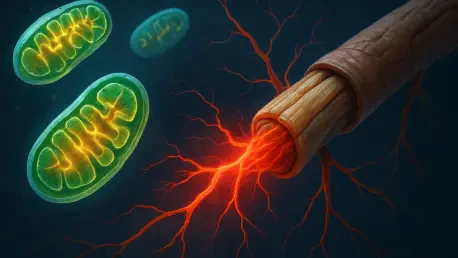

For the millions of people battling chronic nerve pain, where the lightest touch can feel like a searing burn, hope often feels distant. But a groundbreaking study is challenging the way we think about pain, shifting the focus from masking symptoms to repairing the damage at a cellular level. To help us understand this new frontier, we’re joined by biopharma expert Ivan Kairatov, who specializes in translating complex research into tangible insights. We’ll explore the discovery of a hidden cellular support system where healthy cells donate their power packs—mitochondria—to failing neurons. This interview unpacks how this natural process works, the pivotal role of “tunnelling nanotubes” in delivering this aid, and how harnessing this mechanism could create a new class of therapies to treat chronic pain at its source.
Your research showed that replenishing mitochondria reduced pain for up to 48 hours in some cases. Could you walk us through how you administered these healthy mitochondria in your models and describe the specific pain-reducing behaviors you observed during that period of relief?
Of course. It’s one thing to have a theory, but seeing it work is what truly drives the science forward. In our mouse models, which mimicked conditions like diabetic neuropathy and chemotherapy-induced damage, we performed a very precise procedure. We directly injected a solution containing healthy, isolated mitochondria into the dorsal root ganglia. This is a critical cluster of nerve cells that acts like a relay station, sending pain messages to the brain. What we witnessed afterward was remarkable. These mice, which had previously been hypersensitive and would withdraw from even a gentle touch, began to behave differently. They showed a significantly reduced response to stimuli that would normally cause them pain. This relief wasn’t fleeting; it was profound and lasted, in some instances, for up to 48 hours. It was a clear signal that we weren’t just numbing the nerve, we were restoring its function.
The article highlights a “secret life” of satellite glial cells transferring mitochondria through tunnelling nanotubes. Can you elaborate on the key steps you took to uncover this previously undocumented handoff process and explain what this discovery means for understanding glial-neuron communication?
This was the most exciting part of the research, a true “aha!” moment. For decades, we’ve viewed glial cells primarily as the passive support crew for neurons—providing structure and cleaning up waste. But we suspected there was a more active dialogue happening. Using advanced imaging techniques, we observed these two cell types together and saw something incredible: the glial cells were extending these ultra-fine, delicate channels, which we call tunnelling nanotubes, and physically connecting with the nearby sensory neurons. It was like watching them build a microscopic pipeline. Through these pipelines, we witnessed mitochondria—the little energy factories—traveling from the healthy glial cell directly into the struggling neuron. This discovery completely reframes our understanding. Glial cells are not just passive helpers; they are active paramedics, donating their own energy reserves to rescue neurons in crisis. This is a fundamental, previously unknown form of cellular communication and support.
A key finding was that directly injecting mitochondria from healthy donors worked, but samples from people with diabetes had no effect. Can you detail this part of the experiment and explain what this tells us about the specific qualities healthy mitochondria must have to be therapeutically effective?
This was the control experiment that truly locked in our hypothesis. It was a critical test of quality. We sourced two sets of mitochondrione from healthy human donors and another from individuals with diabetes, a condition known to compromise mitochondrial function. We ran the same injection procedure in our mouse models. When we used the healthy mitochondria, we saw that dramatic reduction in pain behaviors we hoped for. But when we used the mitochondria from the diabetic donors, there was absolutely no change. The pain remained. The contrast was stark and unambiguous. It tells us that this therapy is not about just adding more mitochondria; it’s about adding functional ones. The mitochondria themselves must be healthy and capable of producing energy efficiently. You can’t fix a failing power grid by hooking it up to another failing one. This finding is crucial because it establishes a quality standard for any future therapeutic development.
You identified the protein MYO10 as essential for forming the nanotubes that enable mitochondrial transfer. Could you explain how you pinpointed MYO10’s role in this process, and what are the next steps for exploring it as a potential target to boost this natural healing mechanism?
Once we saw these nanotubes, the immediate question was, “What’s the machinery building them?” We began a sort of molecular investigation, looking for proteins known to be involved in constructing a cell’s internal skeleton and creating these kinds of protrusions. MYO10 stood out as a prime suspect. To confirm its role, we conducted experiments where we essentially silenced the gene for MYO10 in the glial cells. The result was definitive: without MYO10, the tunnelling nanotubes failed to form, and the transfer of mitochondria to the neurons ceased. It was like removing the master architect from a construction site—everything just stopped. This makes MYO10 an incredibly exciting therapeutic target. The next step is to find a way to switch it on or enhance its activity. We can now begin screening for small molecules or developing genetic tools that could boost MYO10 expression, effectively encouraging the body to build more of these healing pipelines and bolster its own innate repair mechanism.
What is your forecast for mitochondrial transfer therapies? Considering the need for more high-resolution imaging and research, what is the most realistic timeline and the biggest challenge to overcome before this approach could be tested in human clinical trials for chronic pain?
I am cautiously optimistic that we are looking at a paradigm shift in treating chronic pain. Instead of just managing symptoms, we’re talking about repairing the underlying cellular damage. However, we have to be realistic about the timeline and the hurdles ahead. The single biggest challenge is a technical one: we need to perfect high-resolution imaging techniques to visualize this entire process in living, intact nerve tissue. Seeing it in a dish is one thing, but confirming it happens the same way inside a complex organism is another. We need to be absolutely certain of the mechanism before we intervene in humans. From there, developing a safe and effective delivery method is paramount. I believe a therapeutic strategy focused on boosting the body’s own transfer system, perhaps by targeting MYO10, is the most promising and likely safer initial approach. If preclinical research continues to yield positive results, we might see the first early-stage human trials within the next five to ten years. The path is long, but the potential to offer genuine, lasting relief is a powerful motivator.







