
The acidic microenvironment of a solid tumor, once considered a mere byproduct of metabolism, is now being repurposed as a precise trigger for a new generation of cancer-killing vaccines designed to overcome the limitations of conventional immunotherapies. The development of pH-responsive nanovaccines represents a significant advancement in immunotherapy, offering a strategic approach to targeted drug delivery. This review explores the evolution of this technology, its core design principles, and its performance in preclinical models, providing a thorough understanding of its potential to transform applications like cancer therapy and pave the way for safer, more effective treatments.
An Introduction to Smart Vaccine Platforms
At their core, pH-responsive nanovaccines function as intelligent delivery systems engineered to activate the immune system within specific biological compartments. These platforms are typically composed of three essential components: a nanoscale carrier, a therapeutic antigen payload, and a pH-sensitive element that dictates payload release. They have emerged as a compelling solution to the persistent challenges of conventional vaccines, which often suffer from poor targeting, inadequate immune stimulation, and the risk of systemic side effects.
The true innovation of these platforms lies in their ability to remain stable and inert in the neutral pH of the bloodstream but become active in acidic microenvironments. This targeted activation is particularly relevant for cancer immunotherapy, where the tumor microenvironment (TME) is characteristically acidic (pH ~5.4-6.5). By confining the release of antigens to these sites, nanovaccines can minimize off-target effects and maximize the efficiency of the immune response directly where it is needed most.
Core Mechanisms and Nanomaterial Design
pH-Sensitive Materials and Nanocarriers
The foundation of any pH-responsive nanovaccine is the choice of its carrier material, which must be capable of changing its properties in response to pH shifts. A diverse array of platforms, including polymers, lipids, and inorganic nanoparticles, has been explored for this purpose. The key to their function is the presence of chemical moieties, such as protonatable groups, that alter their charge, structure, or solubility when exposed to acidic conditions.
A promising recent example involves the use of polysaccharide-functionalized carbon dots (Lyc-CDs) derived from natural sources like the Lycium barbarum plant. These materials not only offer excellent biocompatibility but also possess a surface rich in functional groups that enable high antigen loading. This shift toward naturally derived, smart materials forms the basis for creating nanovaccines that are both effective and safe.
Antigen Loading and Triggered Payload Release
Effectively incorporating antigens into a nanocarrier and ensuring their timely release are critical technical challenges. Researchers have developed various strategies to achieve a high antigen-loading capacity, which is essential for inducing a potent immune response. For instance, the unique chemistry of Lyc-CDs allows for an impressive loading capacity of nearly 50%, demonstrating a significant advantage over many other platforms.
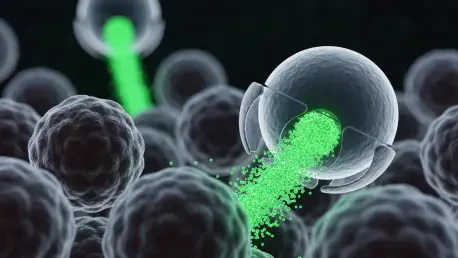
The release mechanism is triggered by the acidic conditions found in the TME or within the endolysosomes of immune cells. This pH drop prompts the disassembly of the nanocarrier or the cleavage of pH-sensitive chemical linkers, releasing the antigenic payload. This precise, triggered release ensures that the antigen is presented to the immune system in the right place and at the right time, dramatically enhancing the efficiency of the vaccination process.
Intrinsic Adjuvanticity and Immune Cell Activation
Many nanocarriers play a dual role, serving not only as delivery vehicles but also as potent immune adjuvants. This intrinsic adjuvanticity is a major benefit, as it can eliminate the need for traditional adjuvant molecules that may cause unwanted side effects. Materials like Lyc-CDs have been shown to directly stimulate key immune cells, such as promoting the maturation of dendritic cells (DCs) to a level comparable with powerful activators like LPS.
Furthermore, these nanomaterials can induce the secretion of pro-inflammatory cytokines, including TNF-α and IFN-γ, which are critical for orchestrating a robust and durable antitumor response. By acting as both carrier and adjuvant, the nanoplatform amplifies the overall immune cascade, leading to more effective activation of the body’s defenses against pathogens or cancer cells.
Recent Advances in Nanovaccine Engineering
The field of nanovaccine engineering is continuously evolving, with researchers focused on enhancing both efficacy and safety. A significant trend is the use of naturally derived, biocompatible materials, such as polysaccharides from the Lycium barbarum plant. These materials improve biosafety profiles and often possess inherent immunogenicity, providing a synergistic boost to the vaccine’s overall performance.
Emerging developments also include the creation of multi-functional platforms that integrate pH-responsiveness with other advanced features. These next-generation systems may incorporate additional targeting ligands to further improve specificity or co-deliver other therapeutic agents, such as checkpoint inhibitors. Such innovations are pushing the boundaries of what nanovaccines can achieve, opening new avenues for combination therapies.
Therapeutic Applications and In Vivo Efficacy
Reprogramming the Tumor Microenvironment
The primary application for pH-responsive nanovaccines is in cancer immunotherapy, where they have shown a remarkable ability to reprogram the TME. By releasing antigens directly within the acidic tumor, these nanovaccines significantly enhance antigen cross-presentation by DCs, a crucial step for initiating a powerful T-cell-mediated attack.
Preclinical studies have demonstrated this effect with compelling results. For example, the Lyc-OVA nanovaccine was shown to inhibit both primary and distal tumor growth by over 80%. This was achieved by activating cytotoxic CD8+ T cells while simultaneously reducing the populations of immunosuppressive cells like regulatory T cells (Tregs) and myeloid-derived suppressor cells (MDSCs), effectively transforming the TME from an immune-suppressive to an immune-active state.
Combating Infectious Diseases
Beyond cancer, pH-responsive nanovaccines hold considerable promise for combating infectious diseases, particularly those caused by intracellular pathogens. Many bacteria and viruses find refuge inside host cells within acidic compartments like phagolysosomes, effectively hiding from the immune system.
By designing nanovaccines that release their antigenic payload specifically within these acidic vesicles, it becomes possible to stimulate a targeted immune response against these otherwise challenging infections. This strategy could lead to more effective vaccines for diseases where traditional approaches have fallen short, offering a new tool in the global fight against infectious agents.
Current Challenges and Translational Hurdles
Despite their promise, several challenges impede the widespread clinical adoption of pH-responsive nanovaccines. On the technical front, scaling up the manufacturing process while ensuring batch-to-batch consistency and long-term stability remains a significant hurdle. These complex nanomedicines require stringent quality control that can be difficult to achieve on an industrial scale.
Biologically, predicting how these systems will behave in humans based on in vitro and animal model data is not always straightforward. Furthermore, navigating the complex regulatory pathways for nanomedicine approval presents a substantial obstacle. Overcoming these technical and regulatory barriers is essential for translating these innovative technologies from the laboratory to the clinic.
Future Outlook and Next-Generation Platforms
The future of pH-responsive nanovaccines is bright, with a clear trajectory toward more personalized and sophisticated platforms. One of the most exciting prospects is the integration of patient-specific neoantigens, which could lead to the development of truly personalized cancer vaccines tailored to an individual’s unique tumor profile.
Another promising avenue is the creation of multi-stimuli responsive systems that react not only to pH but also to other biological cues like specific enzymes or redox conditions. These next-generation platforms could offer even greater precision and control, potentially overcoming resistance to current immunotherapies and solidifying their role as a cornerstone of precision medicine.
Conclusion and Overall Assessment
This review outlined the significant advantages of pH-responsive nanovaccines, which included enhanced targeting, improved immunogenicity, and reduced off-target toxicity. The technology’s core strength was its ability to leverage the acidic microenvironments of tumors and endosomes as a trigger, ensuring that its therapeutic payload was delivered with high precision.
The analysis of platforms like Lyc-OVA underscored the dual functionality of nanocarriers as both delivery vehicles and potent immune adjuvants, a feature that amplified their therapeutic effect. While translational hurdles related to manufacturing and regulation remained, the field’s rapid innovation pointed toward a future where these systems could become a versatile and impactful tool in the treatment of cancer and infectious diseases, heralding a new era of safer and more effective immunotherapies.