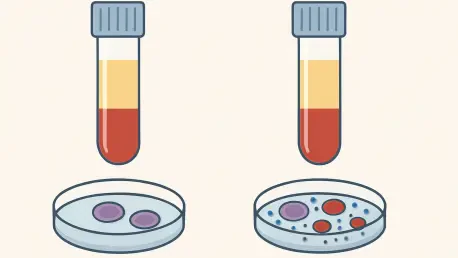

The ability to track cancer’s genetic secrets through a simple blood draw is no longer a futuristic concept but a clinical reality facing its own set of critical challenges. For years, the field of oncology has been steadily moving away from invasive tissue biopsies toward liquid biopsies, a revolutionary approach that analyzes a tumor’s genetic profile from biomarkers like circulating tumor DNA (ctDNA) found in blood. This minimally invasive method promises faster results, less patient discomfort, and a more complete picture of a tumor’s heterogeneity. However, the technologies powering this shift have been locked in a difficult compromise, forcing laboratories to choose between sensitivity, genomic coverage, and workflow simplicity.
This analysis introduces a head-to-head comparison between a formidable new challenger, a next-generation technology named Bridge Capture, and the established commercial assays that currently define the market, specifically Archer LIQUIDPlex and Illumina AmpliSeq CHPv2. All these assays share a fundamental purpose: to detect and analyze ctDNA from a blood sample, providing oncologists with the genetic information needed for diagnostics, disease monitoring, and targeted treatment selection. The clinical value of these tests hinges on their ability to deliver highly sensitive results across a broad genomic landscape with a process simple enough for routine use. As we will see, not all assays are created equal in their ability to balance these critical demands.
A Head-to-Head Comparison: Performance, Efficiency, and Usability
Sensitivity and Variant Detection Thresholds
At the heart of any liquid biopsy assay is its sensitivity—the ability to find the proverbial needle in a haystack. This is particularly critical in oncology, where ctDNA can be present at extremely low concentrations. A direct comparison reveals that Bridge Capture possesses a superior lower limit of detection, successfully identifying genetic variants at the lowest variant allele frequencies (VAFs) among the tested platforms. This enhanced sensitivity means it can reliably detect rare ctDNA signals that other assays, including Archer LIQUIDPlex and Illumina AmpliSeq CHPv2, might miss entirely. This capability is not just an incremental improvement; it is a critical advantage for applications like minimal residual disease (MRD) monitoring, where detecting lingering cancer cells after treatment can predict relapse, and for early cancer detection, where ctDNA levels are inherently low.
However, superior sensitivity is only valuable if the results are accurate. In this regard, Bridge Capture demonstrates strong concordance with both Archer LIQUIDPlex and Illumina AmpliSeq CHPv2 for genetic variants that fall within the detection range of all three assays. This high level of agreement confirms that the new technology is not only more sensitive but also highly reliable and accurate in its findings. For clinical laboratories, this dual assurance is paramount. It validates that Bridge Capture can be trusted to find what is expected while also providing the added power to uncover rare variants that were previously below the threshold of detection, thereby offering a more comprehensive and trustworthy genomic profile.
Operational Efficiency and Cost-Effectiveness
Beyond pure detection power, the practical and economic realities of laboratory operations play a decisive role in technology adoption. A standout feature of Bridge Capture is its remarkable efficiency in using sequencing capacity, a major cost driver for any next-generation sequencing (NGS) assay. Benchmarking studies revealed that the technology maintains near-identical, high-quality results even when the sequencing read depth is reduced ten-fold. This is a pivotal distinction from platforms like Archer LIQUIDPlex or Illumina AmpliSeq CHPv2, which often require deep—and therefore expensive—sequencing to confidently call low-frequency variants. This efficiency directly translates to a lower per-sample cost, a crucial factor for laboratories operating under tight budgets.
The economic implications of this efficiency are profound. By delivering high-sensitivity results without the need for excessive sequencing, Bridge Capture democratizes access to advanced liquid biopsy testing. Laboratories that previously could not afford the high operational costs associated with deep sequencing can now implement a powerful assay for detecting low-VAF mutations. This positions Bridge Capture as a highly cost-effective solution that enables more institutions to offer state-of-the-art molecular diagnostics, expanding patient access and making advanced cancer monitoring more financially sustainable for routine clinical use.
Workflow Simplicity and Scalability
The complexity of a laboratory workflow directly impacts turnaround time, cost, and the potential for human error. Many current broad-coverage liquid biopsy assays involve complex, multi-step procedures that are both time-consuming and difficult to scale. In contrast, Bridge Capture was designed with a streamlined and consistent workflow that minimizes hands-on time and reduces potential failure points. This inherent simplicity makes it easier to implement, validate, and run on a daily basis, contributing to faster and more reliable results.
Furthermore, this technology was engineered for true scalability, addressing a common logistical headache in clinical labs. Unlike systems that require different assays or protocols for different panel sizes, Bridge Capture employs a “one method fits all” design. The core laboratory process remains consistent whether a lab is running a small, focused hotspot panel for monitoring known mutations or a large, comprehensive panel covering hundreds of genes for initial diagnosis. This flexibility allows a single validated workflow to serve diverse clinical needs, from targeted monitoring to broad discovery, without requiring new infrastructure, training, or validation efforts for each application. This unified approach provides laboratories with unprecedented adaptability to meet both current and future testing demands.
Addressing the Core Challenges of Clinical Adoption
For years, the widespread adoption of liquid biopsy has been hindered by a persistent triad of trade-offs. Laboratories using current-generation assays are often forced into a difficult compromise: they can choose a highly sensitive “hotspot” assay that covers only a few genetic variants, or a comprehensive panel with broad genomic coverage that sacrifices sensitivity and involves a much more complex workflow. This dilemma often compels clinical labs to maintain and validate multiple platforms, such as running Archer LIQUIDPlex for one application and Illumina AmpliSeq CHPv2 for another, creating a fragmented and inefficient testing environment.
These operational compromises impose significant practical limitations. Managing multiple distinct workflows increases operational costs, extends turnaround times for results, and elevates the risk of sample-to-sample contamination or procedural errors. A lab might use a fast, focused assay to monitor a known mutation but need a more complex and time-consuming broad panel for initial treatment selection on a new patient. This fragmentation creates a bottleneck, preventing the seamless integration of liquid biopsy into routine cancer care and creating barriers for labs that must choose between speed, sensitivity, and the breadth of genetic information they can investigate.
Bridge Capture was specifically engineered to resolve this long-standing “triad of challenges.” It was developed not to be just another option, but a unified solution that eliminates the need for compromise. By integrating ultra-high sensitivity, broad genomic coverage, and a simple, scalable workflow into a single cohesive platform, it offers a path forward for broader clinical implementation. Its design addresses the reality of modern clinical sequencing, making it an ideal technology for the growing trend of decentralizing cancer testing away from large, central labs and toward regional sites closer to the patient, thereby improving access and accelerating the delivery of critical results.
Conclusion: Choosing the Right Assay for Modern Oncology
In a direct comparison, the evidence demonstrates that Bridge Capture represents a significant leap forward in liquid biopsy technology. It delivers superior sensitivity capable of detecting extremely rare ctDNA variants, achieves greater cost-efficiency by drastically reducing sequencing demands, and offers a more streamlined and scalable workflow compared to established platforms like Archer LIQUIDPlex and Illumina AmpliSeq CHPv2. These combined advantages position it as a powerful tool for advancing precision oncology.
For clinical laboratories, these findings provide clear, practical recommendations. Bridge Capture is ideally suited for applications that demand the highest levels of sensitivity, such as early cancer detection and monitoring for minimal residual disease. It is also an excellent choice for laboratories seeking to consolidate multiple fragmented workflows into a single, efficient, and validated process. Moreover, its simplicity and cost-predictable model make it a prime candidate for facilities aiming to decentralize testing and bring advanced molecular diagnostics closer to the communities they serve.
Ultimately, the choice of a liquid biopsy assay depends on a laboratory’s specific clinical and operational needs. While established assays like Archer LIQUIDPlex and Illumina AmpliSeq CHPv2 remain valuable tools, labs prioritizing the detection of variants at extremely low VAFs or seeking a more scalable and cost-effective model would benefit significantly from adopting a next-generation technology like Bridge Capture. By overcoming the traditional compromises of liquid biopsy, it provides a robust, unified platform poised to make precision diagnostics a more accessible and effective component of modern cancer care.