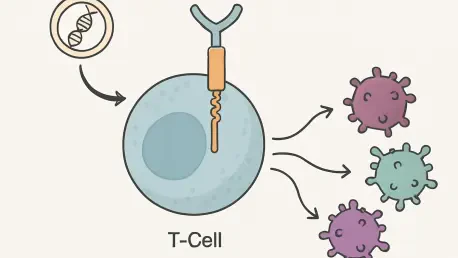

The architectural shift from designing immune cells as single-use biological missiles to constructing them as self-sustaining cellular dynasties marks a profound turning point in modern medicine. While traditional Chimeric Antigen Receptor (CAR) T-cell therapy has provided a lifeline for patients with otherwise terminal blood cancers, it has historically been plagued by a “one-and-done” performance profile. The cells would often enter the body, strike with immense force, and then vanish or exhaust themselves before the job was truly finished. This inherent fragility created a massive clinical gap where half of the treated patients faced relapse within months. The emergence of multi-cytokine engineering represents a sophisticated response to this durability crisis, aiming to transform these “living drugs” into a permanent, self-renewing defense force.
By integrating complex protein signaling directly into the manufacturing phase, researchers have moved beyond simple genetic modification toward a more comprehensive form of cellular programming. This evolution is not merely an incremental improvement; it is a fundamental reimagining of how immune cells interact with their environment and their targets. In the broader technological landscape, this shift mirrors the transition from hardware-centric design to software-defined resilience, where the internal “operating system” of the T cell is optimized for long-term survival rather than just immediate output. As the industry moves into this new era of immunotherapy, the focus has shifted toward creating a biological legacy within the patient that can provide constant surveillance against both cancer and chronic viral threats.
Evolution of Enhanced Chimeric Antigen Receptor (CAR) T-Cell Manufacturing
The trajectory of CAR T-cell therapy began with a primary focus on the receptor itself—the genetic “hook” that allows an immune cell to recognize a specific cancer protein. Early iterations were remarkably effective at identifying targets, but they lacked the metabolic infrastructure to sustain an attack over long periods. As the field matured, it became clear that the context in which these cells were grown was just as important as their genetic programming. Conventional manufacturing methods relied on generic activation signals that essentially “pushed” the cells into an old, exhausted state before they even reached the patient. This resulted in a product that was highly specialized for killing but completely incapable of maintaining its own population.
The context of this evolution is rooted in the hard-learned lessons of the first decade of cellular therapy. Clinical data consistently showed that patients who achieved long-term remission were those who, by sheer biological luck, possessed a small population of persistent “memory” cells. Recognizing this, the technological shift turned toward intentionally engineering this persistence. The goal was no longer just to create a killer cell, but to create a stem-like cell that could spawn generations of killers. This pivot required a move away from crude chemical stimulants toward sophisticated, multi-functional protein scaffolds that could whisper complex developmental instructions to the cells during their sensitive growth phase.
Technical Foundations of the Multi-Cytokine Protein Scaffold
The HCW9206 Signaling Framework
At the heart of this technical revolution lies the HCW9206 signaling framework, a masterpiece of protein engineering that solves the problem of cytokine delivery. In nature, cytokines are the chemical messengers of the immune system, but using them as therapeutic additives is notoriously difficult. If administered separately, they often have short half-lives or cause systemic toxicity. The HCW9206 scaffold overcomes this by fusing three critical signaling molecules—Interleukin-7 (IL-7), IL-15, and IL-21—into a single, stable structure. This fusion ensures that the developing T cells receive a balanced and simultaneous “trinity” of signals, which is far more effective than the haphazard exposure found in traditional laboratory environments.
The performance of this framework is defined by its ability to prevent cellular senescence. IL-7 provides the fundamental survival signals that keep the cell alive, while IL-15 drives the controlled expansion of the cell population without causing the over-activation that leads to burnout. However, the inclusion of IL-21 is perhaps the most strategic choice; it acts as a developmental brake, preventing the cells from maturing too quickly into “effector” cells that die after one battle. By maintaining this delicate equilibrium, the HCW9206 scaffold essentially creates a fountain of youth for the immune system, ensuring the engineered product remains in a highly potent and regenerative state throughout the manufacturing process and beyond.
Enrichment and Programming of T Memory Stem Cells (Tscm)
The real-world manifestation of this signaling framework is the dramatic enrichment of T memory stem cells, or Tscm. These cells are the elite reservists of the immune system, possessing the longevity of a stem cell and the target-specificity of a killer T cell. Under standard manufacturing conditions, these cells are extremely rare, often making up less than five percent of the final therapeutic dose. This scarcity is why so many patients relapse; there simply are not enough “seed” cells to keep the response going. By using the multi-cytokine scaffold, engineers have demonstrated the ability to boost this concentration to over fifty percent, a tenfold increase that fundamentally changes the therapeutic potential of the drug.
The technical significance of this Tscm-heavy population cannot be overstated. When these cells are infused into a patient, they do not just attack the existing disease; they establish a permanent residence in the bone marrow and lymph nodes. From these bases, they can monitor the body for any signs of recurrence. If a cancer cell or a virus-infected cell reappears, the Tscm “re-awaken” and produce a fresh wave of active fighters. This capability represents a move from passive therapy to active immunological vigilance, providing a level of protection that was previously thought to be impossible with synthetic interventions.
Current Trends in Cellular Programming and Metabolic Fitness
The current landscape of cellular programming is increasingly focused on metabolic fitness as the primary metric of success. There is a growing industry-wide realization that an immune cell is only as good as its engine. New innovations are shifting away from simply measuring how many cancer cells a T cell can kill in a lab dish toward analyzing how well the cell manages its energy resources in the harsh, acidic, and oxygen-deprived environment of a human tumor. This metabolic prioritization is leading to the development of cells that favor mitochondrial health over the rapid, inefficient glucose consumption that typically characterizes exhausted cells.
Moreover, there is a distinct trend toward “precision manufacturing” where the duration of the culturing process is significantly shortened. By using potent scaffolds like HCW9206, the time required to produce a therapeutic dose is being slashed, which not only reduces costs but also prevents the cells from spending too much time in an artificial environment. This shift reflects a broader consumer and industry demand for therapies that are not only more effective but also more accessible. The integration of automated, closed-loop bioreactors with these advanced signaling proteins is paving the way for a future where high-quality, stem-like CAR T cells can be produced at scale, moving the technology from a boutique clinical trial phase into a standardized medical staple.
Real-World Applications in Oncology and Virology
In the field of oncology, the deployment of Tscm-enriched therapies has already shown remarkable results in tackling hematologic malignancies that were previously resistant to standard CAR T-cell treatments. In sophisticated mouse models and early human evaluations, these engineered cells have demonstrated a “recall response” that is strikingly similar to natural immunity. When leukemia cells were reintroduced into subjects months after the initial treatment, the scaffold-engineered cells expanded rapidly to eliminate the threat, whereas conventional cells remained dormant and allowed the cancer to spread. This suggests that for diseases like B-cell lymphoma and leukemia, we may be on the cusp of achieving permanent cures rather than just temporary remissions.
The implications for virology are equally transformative, particularly in the ongoing battle against HIV. The primary obstacle to curing HIV has always been the “latent reservoir”—pockets of infected cells that hide from both the immune system and antiretroviral drugs. Because multi-cytokine engineered CAR T cells persist indefinitely, they are uniquely suited to wait out these hidden reservoirs. As the virus attempts to emerge from its dormant state, the persistent T cells can identify and destroy the infected host before the virus can replicate and spread. This application offers a realistic pathway toward a “functional cure,” where patients could potentially remain drug-free for the rest of their lives while their engineered immune system maintains a state of constant suppression.
Technical Barriers and Implementation Hurdles
Despite the clear potential, several technical barriers continue to complicate the widespread adoption of multi-cytokine engineering. One of the most pressing concerns is the risk of over-activation, which can lead to cytokine release syndrome (CRS) or neurotoxicity. When you engineer a cell to be incredibly persistent and powerful, you also increase the potential for the immune system to overreact, causing dangerous inflammation. Developing “safety switches”—genetic circuits that can turn the cells off if they become too aggressive—is an ongoing area of intense research that must be perfected before these therapies can be moved into earlier lines of treatment.
Implementation hurdles also extend to the regulatory and economic spheres. The multi-component nature of these protein scaffolds adds layers of complexity to the manufacturing process, which can drive up costs in an already expensive field. Ensuring consistency across different batches and different patient starting materials remains a significant challenge. Regulatory agencies require stringent proof of safety for “living drugs” that are designed to last for decades, as the long-term presence of genetically modified cells carries theoretical risks of secondary cancers or unanticipated immune complications. Overcoming these hurdles will require a collaborative effort between biotechnologists, clinicians, and policymakers to create a streamlined path for these advanced technologies.
Future Horizons: Toward Permanent Immunological Vigilance
The future of CAR T-cell engineering is trending toward the creation of fully autonomous immune agents that require no external maintenance. We are moving toward a horizon where the signaling scaffolds currently used in the lab are integrated directly into the cell’s genome. This would allow the T cells to produce their own IL-7, IL-15, and IL-21 only when they encounter their target, creating a self-sustaining feedback loop. Such “fourth-generation” CAR T cells would essentially act as an independent, synthetic branch of the immune system, capable of adapting to the evolving landscape of a disease without further intervention from a physician.
Beyond oncology and virology, the long-term impact of this technology may extend into the treatment of autoimmune diseases and age-related immune decline. If we can master the art of programming T memory stem cells, we could theoretically reset an overactive immune system or replenish a failing one in the elderly. The long-term vision is the establishment of permanent immunological vigilance—a state where a single infusion provides a lifetime of protection against a variety of threats. As gene editing tools like CRISPR become more precise, the ability to weave these complex multi-cytokine circuits into the human biological fabric will likely become the gold standard for preventative and curative medicine.
Strategic Assessment of Multi-Cytokine Engineering
The strategic assessment of multi-cytokine engineering confirmed that the durability of an immune response was the single most important factor in determining therapeutic success. The technology demonstrated that by shifting the focus from immediate cytotoxicity to long-term memory stem cell enrichment, the industry successfully addressed the primary cause of CAR T-cell failure. The development of the HCW9206 scaffold provided a standardized, high-performance method for achieving this enrichment, effectively removing the “biological lottery” that previously dictated which patients would survive and which would relapse. This transition from a fragile, short-term intervention to a resilient, long-term biological safeguard represented a paradigm shift in how we approach chronic and terminal illnesses.
Ultimately, the impact of this engineering breakthrough was felt across the entire biopharmaceutical sector, as it provided a clear blueprint for the next generation of cellular therapies. The ability to transform 5% Tscm populations into 50% populations was not just a technical victory; it was a clinical game-changer that made functional cures a tangible reality. While challenges regarding cost and regulatory oversight remained, the proof of concept established by these multi-cytokine frameworks was undeniable. The technology moved the needle from managing symptoms to eradicating disease reservoirs, ensuring that the future of medicine is defined by the endurance of the cure rather than the persistence of the ailment.