
The world of oncology is shifting its focus from the cancer cells themselves to the complex environment that sustains them. Ivan Kairatov, a biopharma expert with extensive experience in research and development, joins us to discuss a groundbreaking discovery from the University of Oklahoma. For years, scientists observed that aggressive tumors were often shot through with a dense web of nerves, yet the origin of these nerves remained a mystery. New findings in triple-negative breast cancer have finally revealed a startling betrayal: the tumor hijacks our own immune defenders to build its own communication and nutrient network. Our conversation explores the sinister transformation of macrophages, the chemical beacons that lure nerves into the “lion’s den” of a tumor, and how blocking these signals could revolutionize treatment for some of the most difficult cancers to treat.
Could you walk us through how a cell typically responsible for our protection, the macrophage, ends up contributing to the growth of a lethal tumor?
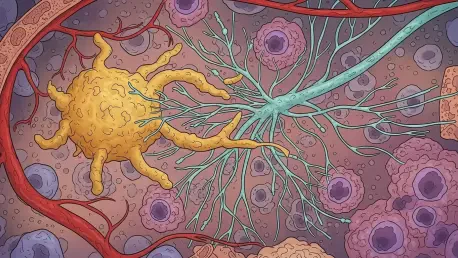
In a healthy body, macrophages are the dedicated first responders of the immune system, acting as both a clean-up crew and a defense force that gobbles up pathogens and heals wounded tissue. However, in the aggressive environment of triple-negative breast cancer, these cells are effectively brainwashed or co-opted by the malignancy to serve a much darker purpose. Once these macrophages are recruited into the tumor site, they stop acting as defenders and start acting as architects for the cancer’s infrastructure. It is a profound biological subversion where the tumor uses the macrophage’s natural healing signals to facilitate its own expansion. Instead of identifying the cancer as a threat to be eliminated, these “hijacked” macrophages begin secreting proteins that make the tumor more resilient and better connected to the rest of the body.
What is the specific mechanism or “signal” that these co-opted macrophages use to draw nerves into the cancerous mass?
The primary tool used in this process is a protein called brain-derived neurotrophic factor, or BDNF, which acts like a powerful chemical beacon or a flare in the dark. In a normal context, BDNF is a hero of the central nervous system, where it helps our brain cells grow, survive, and maintain the connections that allow us to think and move. The tragedy here is that triple-negative breast cancer tumors seize this exact same signal, using the macrophages as the “delivery system” to flood the area with BDNF. Nearby nerves, sensing this high concentration of growth factor, are lured toward the tumor and begin to branch out and infiltrate the mass in a process known as axonogenesis. This creates a physical network within the tumor that didn’t exist before, essentially “plugging” the cancer into the body’s nervous system.
How does the presence of these newly recruited nerves actually change the way a tumor behaves and responds to treatment?
Once the nerves have successfully infiltrated the tumor, they function as a sort of support system that makes the cancer much more aggressive and difficult to eradicate. Research suggests that these nerves are immunosuppressive, meaning they create a “shield” that prevents other immune cells from attacking the cancer, which explains why these tumors are so resistant to traditional therapies. Furthermore, these nerves aren’t just there for show; they appear to encourage the growth of new blood vessels that deliver a steady stream of oxygen and nutrients to the rapidly dividing cells. There is also evidence that tumor cells can literally crawl along these nerve fibers, using them as high-speed highways to escape the original site and spread, or metastasize, to other parts of the body. This multi-layered support system is why tumors with high nerve density are so much more lethal than those without this neural architecture.
When researchers looked beyond the lab and analyzed data from human patients, what did the numbers reveal about the relationship between BDNF and survival?
The clinical data from patients with triple-negative breast cancer provided a sobering confirmation of what was observed in the laboratory models. When the research team analyzed patient records, they found a direct and significant correlation between high levels of macrophages and BDNF and much poorer survival outcomes. This indicates that the more successful a tumor is at recruiting these immune cells and pumping out that specific growth protein, the more dangerous it becomes for the patient. Seeing these same patterns in human tissue reinforces the idea that this “nerve-attraction” mechanism is a fundamental driver of the disease’s progression. It transforms the study from a biological observation into a critical clinical target, as the presence of these signals serves as a clear indicator of a more aggressive, treatment-resistant form of cancer.
Given that these discoveries were made in triple-negative breast cancer, do you see this mechanism playing a role in other types of malignancies that are currently hard to treat?
There is a very high probability that this “neuro-immune” crosstalk is a common strategy used by other aggressive, solid tumors to ensure their survival and spread. The researchers are already planning to test these findings in the context of high-grade ovarian cancer, which shares many of the same devastating characteristics and treatment hurdles as triple-negative breast cancer. Both of these cancers are notorious for their ability to resist standard chemotherapy and for their tendency to recur even after seemingly successful treatment. If we find that macrophages are also secreting BDNF to lure nerves into ovarian tumors, it would suggest that we have uncovered a universal “survival kit” used by cancers to thrive in the human body. This opens up the possibility of a broad-spectrum therapy that could treat multiple types of cancer by targeting the microenvironment rather than just the cancer cells.
How does the use of existing drugs to block BDNF change the landscape of how we might treat patients in the near future?
The prospect of using drugs already on the market to block BDNF signaling is incredibly exciting because it could significantly shorten the timeline for bringing new treatments to patients. In mouse studies, using a drug to disrupt the communication between macrophages and nerves led to a dramatic reduction in tumor growth and prevented the nerves from ever taking root. By stopping the nerves from infiltrating the tumor in the first place, we might be able to “turn the lights back on,” essentially stripping the cancer of its immunosuppressive shield and allowing the patient’s own immune system to recognize and reject the tumor. This approach shifts the strategy from a “scorched earth” policy of killing all cells to a more tactical “disruption of service” that cuts off the tumor’s vital support lines. It provides a more nuanced way to fight cancer that could be far less toxic and far more effective than the heavy-handed treatments we have relied on for decades.
What is your forecast for the role of neuroscience in oncology over the next decade?
I believe we are entering an era where “cancer neuroscience” will become just as fundamental to oncology as genetics or immunology. Over the next ten years, I expect we will move away from seeing tumors as isolated clusters of cells and instead treat them as complex, “smart” organs that actively integrate themselves into our nervous system. We will likely see the development of a new class of “neuro-immunotherapies” that focus specifically on breaking the dialogue between the brain, the nerves, and the tumor microenvironment. By the 2030s, I forecast that routine cancer biopsies will include “nerve density” and “neurotrophic protein” screenings to help doctors choose the most effective inhibitors to starve a tumor of its neural support. Ultimately, our goal is to render the tumor “blind and isolated,” making it an easy target for our own natural defenses to finish the job.