
For countless individuals living with Immune Thrombocytopenia, the daily reality involves a constant balancing act of managing medication schedules and navigating the persistent threat of dangerously low platelet counts. The prospect of a life free from this chronic treatment burden has long seemed a distant hope. However, recent clinical developments suggest that this hope may be closer than ever, with a novel therapy poised to fundamentally alter the treatment landscape. This potential shift away from lifelong management toward durable, treatment-free remission could redefine what it means to live with ITP.
Navigating the Current ITP Treatment Landscape
Immune Thrombocytopenia is an autoimmune disorder where the body’s own immune system erroneously targets and destroys platelets, the small cell fragments essential for blood clotting. This internal assault leaves patients vulnerable to bruising, bleeding, and, in severe cases, life-threatening hemorrhages. The chronic nature of the disease often imposes a significant physical and psychological toll, as patients live with uncertainty and the side effects of continuous therapy.
The standard of care for ITP typically begins with corticosteroids to rapidly increase platelet counts by suppressing the immune system. While often effective in the short term, their long-term use is associated with considerable side effects. For patients who do not achieve a lasting response, the next line of defense includes thrombopoietin receptor agonists (TPO-RAs), such as Novartis’s own Promacta, which stimulate the bone marrow to produce more platelets. These therapies represent a chronic management strategy, requiring continuous administration to maintain safe platelet levels.
This reliance on lifelong medication underscores a significant unmet medical need within the ITP community. Patients and clinicians alike have long sought a short-course therapy capable of inducing durable remission, thereby freeing individuals from the relentless cycle of daily pills, regular monitoring, and the cumulative toxicity of long-term drug exposure. A treatment that could reset the immune system rather than merely manage the symptoms would not only improve clinical outcomes but also dramatically enhance patient quality of life.
A New Dawn in ITP Therapy Ianalumabs Clinical Triumph
Innovating Beyond Platelet Production Ianalumabs Dual Action Approach
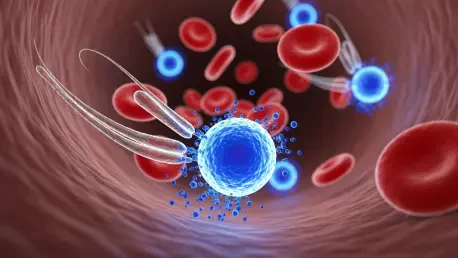
Ianalumab introduces a novel therapeutic strategy that moves beyond simply stimulating platelet production. Its innovative mechanism of action targets the root cause of the autoimmune attack through a dual approach. First, it depletes the misfiring B-cells responsible for producing the autoantibodies that destroy platelets. Simultaneously, it blocks a critical signaling pathway that is necessary for the creation of new B-cells, effectively cutting off the supply of these problematic immune cells. This two-pronged assault aims to induce a deeper and more lasting remission than existing treatments.
The development of ianalumab has become a cornerstone of Novartis’s strategic vision, particularly following its $2.9 billion acquisition of MorphoSys. Initially seen as one of several key assets in the deal, ianalumab’s clinical success has provided a significant boost, especially as other pipeline drugs have faced developmental headwinds. Its promising performance is not limited to ITP; the drug had already demonstrated positive results in trials for Sjögren’s syndrome, validating its mechanism as a potentially powerful platform for treating a range of B-cell-mediated autoimmune diseases.
Decoding the Vayhit2 Trial Compelling Data and Promising Outcomes
The Phase 3 Vayhit2 study was designed to test a groundbreaking hypothesis: that a finite, 16-week course of ianalumab combined with Promacta could establish durable disease control long after treatment cessation. The trial enrolled 152 ITP patients who had previously responded to steroids but subsequently relapsed, randomizing them to receive either a high or low dose of ianalumab or a placebo, all in combination with Promacta. The primary objective was to measure the time until treatment failure, defined as a drop in platelet counts or the need for rescue medication.
Results presented at the American Society of Hematology meeting demonstrated a clear and statistically significant victory for ianalumab. The high-dose group showed a remarkable 45% reduction in the risk of treatment failure compared to the placebo arm. This translated into a median time to failure of 13 months for those on the high dose, a substantial extension from the 4.7 months seen in the placebo group. Furthermore, 62% of patients in the high-dose cohort maintained a stable platelet response at six months, compared to just 39% in the control group.
Crucially, this impressive efficacy was not accompanied by a prohibitive safety burden. The drug was well-tolerated across the study, with the rate of adverse events being similar between the ianalumab and placebo groups. Only a single severe adverse event, a case of heart palpitations, was deemed related to the study drug, suggesting a favorable benefit-risk profile that will be critical for regulatory review and eventual clinical adoption.
Hurdles on the Horizon From Clinical Trial to Clinical Practice
Despite the highly encouraging data from the Vayhit2 trial, the journey from a successful clinical study to routine clinical practice is fraught with challenges. A key question that remains is the long-term durability of the response. While a median of 13 months without treatment failure is a major step forward, clinicians and patients will want to see data extending over several years to confirm that this short-course therapy can truly induce lasting remission. Furthermore, identifying which patient subgroups are most likely to benefit will be essential for optimizing its use in a real-world setting.
Beyond the clinical considerations, market access and affordability present another significant hurdle. As a novel biologic therapy, ianalumab is expected to carry a premium price tag. Payers and health systems will conduct rigorous evaluations to determine its cost-effectiveness compared to existing chronic therapies. Gaining widespread formulary access and ensuring patient affordability will be critical for ianalumab to realize its full potential and reach the broad population of ITP patients who could benefit from it.
The Path to Approval Navigating the Regulatory Gauntlet
With positive Phase 3 data in hand, Novartis is preparing for the next critical phase: the regulatory journey. The company has announced its intention to submit ianalumab for approval to the U.S. Food and Drug Administration (FDA) and other global health authorities in 2025. This process will involve a meticulous review of the complete data package from the Vayhit2 study, as well as supporting data from earlier trials.
Regulators will scrutinize several key aspects of the submission. The primary focus will be on the robustness of the efficacy data, particularly the magnitude and durability of the treatment-free response. They will also carefully assess the long-term safety profile to ensure the benefits of a short-course immune-depleting therapy outweigh any potential risks. The clarity and strength of these data points will be paramount in shaping the final label and any post-marketing commitments.
Given the significant unmet need for durable, non-chronic therapies in ITP, ianalumab could be a candidate for an expedited review process. If regulators agree that it offers a major advance over available treatments, it may be granted a priority review, which would shorten the time to a final decision. Such a designation would reflect the transformative potential of the drug and accelerate its availability to patients awaiting new options.
Redefining Remission The Future of ITP Management
Leading hematology experts have been quick to recognize the profound implications of the Vayhit2 results. Dr. Vinod Pullarkat of the City of Hope cancer center labeled the regimen “paradigm-changing,” a sentiment echoed by others in the field. The core of this excitement lies in the potential to shift the fundamental goal of ITP treatment away from perpetual management toward achieving a durable, treatment-free state. This would represent not just an incremental improvement but a complete redefinition of success for ITP patients.
This potential for treatment-free remission fundamentally alters the long-term outlook for individuals with ITP. For the first time, a significant portion of patients may have a viable path to discontinuing all ITP medications without a rapid relapse. This would alleviate the burden of daily dosing, reduce the risk of long-term side effects, and empower patients with a greater sense of control over their health and future.
The success of ianalumab’s dual-action mechanism also carries broader implications for the field of immunology. By proving its efficacy in both ITP and Sjögren’s syndrome, the drug has established a powerful proof of concept for targeting B-cell pathways in autoimmune diseases. This opens the door for its investigation in other conditions driven by similar pathology, potentially heralding a new class of therapies capable of resetting immune tolerance across multiple disorders.
Final Verdict A Genuine Breakthrough for ITP Patients
The successful outcome of the Vayhit2 Phase 3 trial marked a significant achievement for ianalumab, solidifying its potential as a transformative therapy for Immune Thrombocytopenia. Its ability to provide durable disease control with a short course of treatment directly addressed one of the most pressing unmet needs in the management of this chronic condition. The data presented a compelling case for a new standard of care that prioritizes long-term, medication-free remission.
Ultimately, ianalumab appears to represent a genuine paradigm shift. While regulatory and market access hurdles must still be cleared, the clinical evidence points toward a future where ITP management moves beyond chronic suppression to finite, curative-intent therapy. The drug’s unique mechanism and strong efficacy data offer more than just another treatment option; they provide a blueprint for a new therapeutic philosophy in autoimmune disease.
This development has ignited a renewed sense of optimism within the ITP community. For patients who have long navigated the complexities of lifelong treatment, the prospect of a future with less medication and greater disease control is no longer a distant dream but an approaching reality. The journey of ianalumab from clinical trial to clinic will be watched closely, as it carries the hope of fundamentally improving the lives of thousands.