
A long-standing paradox in oncology has puzzled researchers for decades: while increasing age is a primary risk factor for breast cancer, women who experience their first pregnancy before the age of 30 receive a remarkable and lifelong reduction in their risk. Recent research from cell biologists at the University of California, Santa Cruz, has shed new light on this phenomenon, offering a compelling cellular explanation that moves far beyond previous hormonal theories. The study, detailed in Nature Communications, suggests that pregnancy fundamentally remodels the aging process within mammary tissue, acting as a powerful “cellular reset” that prevents the accumulation of potentially precancerous changes. This breakthrough not only solves a persistent biological mystery but also opens new avenues for understanding and potentially preventing age-related breast cancer by pinpointing the specific cellular changes that pregnancy counteracts, leaving a lasting imprint of stability on the breast’s cellular landscape for decades to follow.
Unmasking the Culprits of Age-Related Risk
At the heart of this discovery lies the identification of a specific, high-risk cell population that quietly builds up in breast tissue as a consequence of aging without the intervention of pregnancy. By employing a sophisticated mouse model engineered to mirror human reproductive and aging timelines, the research team utilized high-resolution single-cell RNA sequencing to analyze thousands of individual mammary cells. This meticulous analysis revealed a striking finding in the aged mice that had never been pregnant: a significant accumulation of “confused” hybrid epithelial cells. These aberrant cells are characterized by their unusual simultaneous expression of molecular markers for both of the major mammary cell lineages—luminal and basal. This loss of a clear cellular identity, a state known as lineage infidelity, is a well-documented hallmark of cellular instability that is often observed in the prelude to cancer. The location of these cells in the basal layer of the mammary gland, a region where many breast tumors are thought to originate, further solidifies them as plausible culprits in age-related cancer development.
The investigation went a step further by identifying a critical molecular driver associated with the hazardous nature of these abnormal cells: an inflammatory signaling molecule known as Interleukin-33 (IL-33). The research team found that the hybrid cells were a prominent source of the IL-33 signal. To determine its functional role, the scientists conducted elegant experiments where they treated mammary epithelial cells from young mice with IL-33. The results were telling, as the IL-33 exposure prompted the young, healthy cells to adopt behaviors characteristic of cells from the aged, nulliparous animals. Specifically, the treatment increased cell proliferation and significantly enhanced their ability to form organoids—miniature, lab-grown tissue structures. This effect was particularly pronounced when combined with the suppression of the critical tumor-suppressor gene Trp53. These induced changes closely mimic the uncontrolled growth and structural alterations seen in the initial stages of tumor formation, providing strong evidence that the IL-33 signal present in the hybrid cells actively contributes to a pro-tumorigenic environment within the aging breast tissue.
The Lasting Legacy of a Cellular Remodel
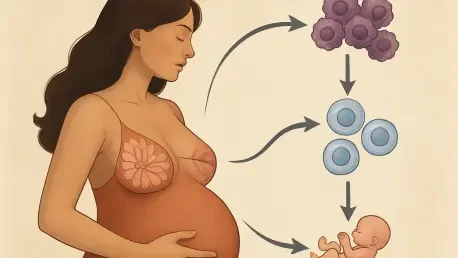
In stark contrast to the cellular disarray promoted by aging alone, the research demonstrates that an early pregnancy acts as a powerful preventative mechanism. The study’s findings posit that pregnancy serves as a definitive “cellular reset button” for the entire mammary gland. By compelling the mammary epithelial cells to undergo a full, rigorous cycle of differentiation to produce milk, followed by a period of organized tissue remodeling known as involution after weaning, pregnancy enforces strict “lineage integrity.” This fundamental biological event effectively purges the tissue of the confused, lineage-infidelic hybrid cells and prevents them from accumulating over time. This offers a direct and elegant explanation for pregnancy’s enduring protective power, revealing that it leaves a permanent legacy of cellular order and stability that actively resists the decay and confusion associated with aging. This is not merely a transient hormonal effect but a profound and permanent reshaping of the breast’s cellular architecture.
Beyond the specific elimination of the hybrid cells, pregnancy was found to restore a broader cellular balance within the aging breast tissue, reinforcing its long-term health. In the aged mice that had experienced pregnancy, the typical age-related expansion of basal cells was normalized, returning the tissue to a more youthful composition. Furthermore, both basal and luminal cells from these mice showed a diminished capacity to form organoids in laboratory settings, indicating a less proliferative and more stable cellular state. An additional and particularly intriguing discovery was that luminal cells in the aged parous mice retained specific molecular signatures associated with the “post-pregnancy involution” phase. The study’s authors suggest this lasting molecular memory may make the cells more visible to the body’s immune system. This enhanced visibility could amplify immune surveillance, adding another critical layer of cancer protection by ensuring that any potentially abnormal cells are more readily identified and eliminated by immune cells patrolling the tissue.
A New Blueprint for Future Prevention
The comprehensive findings from this research provided a cohesive and powerful narrative that fundamentally reshapes our understanding of breast cancer risk. It became clear that aging, in the absence of an early pregnancy, allowed for the gradual and dangerous accumulation of aberrant, lineage-confused hybrid cells within the mammary gland. These cells, through their close association with the inflammatory signal IL-33, were shown to create an environment conducive to uncontrolled cell growth and, ultimately, tumor initiation. An early pregnancy interrupted and effectively reversed this hazardous process by inducing a potent wave of cellular differentiation that purged these unstable cells and reinforced the tissue’s structural and cellular integrity. This “reset” was not a temporary fix but an event that left a permanent, protective imprint, thereby lowering the risk of developing breast cancer decades later. While the study was conducted in a mouse model, the strong parallels in mammary biology and cancer statistics suggested these principles are highly relevant to human health, identifying these hybrid cells as a plausible new target for future prevention strategies.