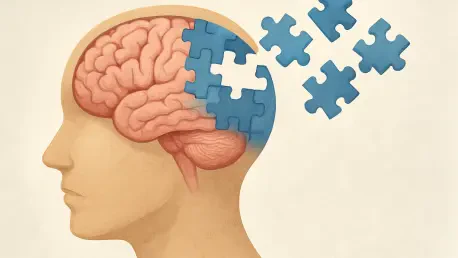

For over a century, Alzheimer’s disease has been seen as an irreversible decline, a one-way street of cognitive loss. But what if the brain holds the capacity to repair itself, even from advanced stages of the disease? Recent findings have challenged this long-held dogma, suggesting that restoring the brain’s fundamental energy balance could not only halt but actively reverse the devastating effects of Alzheimer’s. To help us understand this potential paradigm shift, we are joined by biopharma expert Ivan Kairatov. He will walk us through the science behind a unique compound that restored full cognitive function in animal models, the crucial role of a cellular energy molecule called NAD+, and what these discoveries could mean for future human trials and the very goal of Alzheimer’s treatment.
Your study challenges the long-held view that Alzheimer’s is irreversible. Can you describe the specific result that first suggested you were seeing not just a slowing of the disease, but an actual reversal of advanced pathology and a recovery of cognitive function in the mice?
It wasn’t one single data point, but rather a cascade of positive results that built a powerful case for reversal. Initially, we were cautiously optimistic, but the truly striking moment came when we looked at the whole picture in mice that already had advanced disease. We saw the physical machinery of the brain starting to repair itself on a profound level—the blood-brain barrier was strengthening, inflammation was subsiding, and even the degeneration of axons was being reversed. But the most incredible part was seeing these cellular repairs translate directly into functional recovery. These mice, which had severe cognitive impairments, were not just getting a little better; they were fully recovering their cognitive abilities. Seeing them navigate tasks as well as healthy mice, after having such advanced pathology, was the moment we knew we were witnessing something beyond mere disease prevention. It was true recovery.
The article highlights the decline of the NAD+ energy molecule in AD brains. Could you walk us through the step-by-step process of how your P7C3-A20 compound restores this balance differently than over-the-counter supplements, and what specific cellular functions it repairs?
Think of NAD+ as the fundamental currency of energy within every cell. As we age, our NAD+ levels naturally decline, but in the brains of people with Alzheimer’s, this decline becomes a catastrophic energy crisis. The cells simply can’t execute the critical processes needed to survive and function. Now, one might think the solution is to just flood the system with NAD+ precursors, which is what many over-the-counter supplements do. However, that’s a very blunt approach. Animal studies have shown this can push cellular NAD+ to dangerously high, or “supraphysiologic,” levels that can actually promote cancer. Our P7C3-A20 compound works with much more finesse. It doesn’t force-feed the cells. Instead, it acts as a stabilizer, enabling the cells to maintain their own proper, healthy balance of NAD+ even under the overwhelming stress caused by Alzheimer’s. By restoring this energy equilibrium, the brain’s cells regain the power to perform essential repairs, like mending damaged axons, reducing neuroinflammation, and supporting the birth of new neurons in the hippocampus.
You achieved success in two distinct mouse models, one for amyloid and one for tau. What specific metrics did you use to measure “full cognitive recovery,” and were there any notable differences in the recovery timeline or process between these two different models of the disease?
Measuring “full cognitive recovery” was a comprehensive process. We couldn’t just rely on one behavioral test. We assessed a whole suite of pathological and functional markers. On a biological level, we confirmed the reversal of damage across multiple systems: the blood-brain barrier firmed up, neuroinflammation cooled down, and synaptic transmission improved. We even saw impaired hippocampal neurogenesis—the birth of new brain cells in the memory center—get back on track. Functionally, we saw mice with severe impairments fully regain their abilities in memory and learning tasks. The most compelling part was achieving this in two very different models. One was engineered with human mutations related to amyloid processing, and the other with a human mutation in the tau protein. Seeing this profound recovery in both strengthens the idea that restoring NAD+ balance is a core, fundamental mechanism for repair, rather than a treatment that only targets one specific downstream effect of the disease. This consistency across different genetic drivers gives us much greater confidence in its potential.
The normalization of phosphorylated tau 217 is a key finding, as it’s a clinical biomarker in people. Beyond confirming reversal in mice, how does this specific result help design and streamline the process for potential human clinical trials in the future?
This finding is an absolutely critical bridge between our laboratory work and future human trials. In the clinical world, elevated blood levels of phosphorylated tau 217, or p-tau217, have recently been approved as a reliable biomarker for Alzheimer’s disease in people. The fact that our treatment dramatically normalized these levels in our mouse models is incredibly significant. It gives us a direct, translatable endpoint. Instead of relying solely on cognitive tests, which can be slow to show change and have some variability, we could potentially use a simple blood test in a human trial. This would allow us to monitor the biological effect of the drug in real-time, confirming that it’s hitting its target and reversing the underlying pathology. This could make clinical trials faster, more efficient, and provide much clearer evidence of whether the treatment is working on a molecular level.
What is your forecast for the future of Alzheimer’s treatment? Based on your findings, do you envision a time where recovery from neurodegeneration becomes a standard therapeutic goal, moving beyond simply aiming to slow the disease’s progression?
I believe these results signal a message of profound hope and a necessary paradigm shift for the entire field. For decades, the best we could aim for was to slow the decline—to manage an inevitable process. This research challenges that foundational assumption. It demonstrates that the damaged brain, under the right conditions, can repair itself and regain function. The key takeaway is that the effects of Alzheimer’s may not be permanent. So, yes, I absolutely envision a future where recovery is the standard therapeutic goal. While this new approach must be moved into carefully designed human trials to confirm its efficacy, it opens the door to a new way of thinking. We are now encouraged to develop complementary approaches aimed at reversal and to investigate if this strategy is effective in other neurodegenerative diseases. The ultimate goal is no longer just to hold the line, but to help patients recover what they have lost.