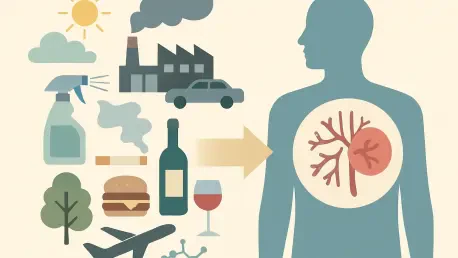

The long-standing scientific pursuit of understanding chronic illness has traditionally centered on the intricate mapping of the human genome to find the origins of our most persistent ailments. For several decades, researchers operated under the assumption that the answers to cardiovascular disease, diabetes, and various cancers were hidden exclusively within the three billion base pairs of our DNA. While this genetic focus yielded critical markers for disease susceptibility, it increasingly became clear that genetics represents only a fraction of the total health equation. To address the remaining mysteries of human pathology, a pioneering movement led by investigators at Harvard Medical School has shifted its focus toward the “exposome.” This comprehensive framework encompasses the totality of non-genetic influences that an individual encounters from conception through old age, offering a much-needed counterbalance to the genome-centric view of modern medicine.
Quantifying the Environmental Landscape
Large-Scale Data and Systematic Methodology
The transition toward a comprehensive understanding of environmental impact required a departure from the fragmented research models that have historically dominated the field of public health. Rather than investigating a single chemical or dietary habit in isolation, the research team utilized twenty years of granular data from the National Health and Nutrition Examination Survey to build a massive repository of human-environment interactions. This systematic effort involved testing over 115,000 unique associations between 619 distinct environmental exposures and 305 clinically relevant health outcomes. By moving away from the “one-at-a-time” approach, the scientists were able to simulate the actual conditions of human life, where individuals are simultaneously exposed to a cocktail of pollutants, nutrients, and social stressors. This high-throughput methodology mimics the rigor of genome-wide association studies, allowing for a neutral and objective assessment of which environmental factors truly move the needle on public health.
Building upon this rigorous statistical foundation, the study provided a blueprint for what is now known as “exposome-wide” analysis, a technique that scans the entire environmental spectrum for disease links. The researchers examined a wide range of physiological metrics, including lung function, systemic inflammation, and metabolic markers like blood sugar and body mass index. This approach is particularly effective because it eliminates the cherry-picking of data that often leads to sensationalized but ultimately irreproducible findings in nutritional or environmental science. By evaluating hundreds of variables across thousands of individuals over a two-decade span, the team established a reliable baseline for how the modern industrial environment interacts with human biology. This methodology ensures that the findings are not merely anecdotal but are grounded in the same level of statistical confidence that clinicians expect from high-level genetic research, providing a more stable platform for future health interventions.
Establishing New Standards for Environmental Analysis
A significant challenge in environmental health has always been the ephemeral nature of exposure, which makes it difficult to track and quantify compared to the static nature of the human genome. To overcome this, the research team applied sophisticated bioinformatic tools to harmonize diverse datasets, ensuring that variables as different as air quality and vitamin levels could be compared on a level playing field. This innovation allows for the detection of subtle patterns that would be invisible in smaller, more localized studies. For example, by analyzing data from 2026 and looking back through the previous two decades, the researchers could see how shifts in industrial regulations or dietary trends correlated with changes in population-wide health markers. This creates a dynamic map of human health that evolves as the environment changes, offering a level of detail that was previously unattainable through traditional epidemiological methods or small-scale laboratory experiments.
Furthermore, this systematic methodology provides a necessary corrective to the “noise” often found in health reporting, where a single study might suggest a specific food causes or prevents a disease. By utilizing a massive, centralized dataset like the National Health and Nutrition Examination Survey, the Harvard-led team could filter out coincidental correlations and focus on associations that remained robust across different demographic groups. This focus on reproducibility is essential for the credibility of the field, as it moves environmental science toward a more predictive and less reactive posture. The ability to quantify the relative importance of hundreds of factors simultaneously means that public health resources can be directed toward the most impactful interventions. This shift toward data-heavy, systematic analysis marks the beginning of a more mature era for the study of the exposome, where the complexity of the modern world is embraced rather than ignored for the sake of simplicity.
The Cumulative Impact of Life’s “Soup”
Statistical Power of Aggregate Exposures
The most striking revelation from recent exposome research is the realization that looking for a “smoking gun” in environmental health is often a futile endeavor. The data indicates that individual environmental factors, such as a specific pesticide or a single dietary supplement, typically account for less than one percent of the variation in health outcomes across a population. However, the true power of the environment is revealed when these factors are viewed in aggregate, forming a “cumulative soup” of exposures. When researchers considered twenty different variables simultaneously, the explanatory power for over 120 medical conditions rose significantly, often reaching levels that rival or exceed the influence of well-known genetic predispositions. This suggests that while a single exposure might be harmless, the synergistic effect of dozens of minor stressors can create a profound biological burden that eventually manifests as chronic disease or metabolic dysfunction.
In specific areas of health, the impact of these combined environmental factors was even more pronounced than anticipated by earlier models. For instance, a specific cluster of variables—including the presence of trans fats, vitamin levels, and industrial pollutants like polychlorinated biphenyls—was found to explain 43 percent of the variation in triglyceride levels. This finding is particularly important because high triglycerides are a primary driver of heart disease, yet many clinical approaches focus heavily on genetics or single lifestyle changes. By demonstrating that nearly half of the variation in a critical health marker can be explained by a specific set of environmental interactions, the study highlights the enormous potential for targeted environmental management. It reframes the conversation around disease risk from one of genetic destiny to one of cumulative environmental management, where the total weight of life’s daily exposures determines long-term wellness.
The Synergistic Effects of Modern Living
The concept of the “cumulative soup” extends beyond simple addition; it suggests that different environmental factors can interact in ways that amplify their individual effects. For example, the impact of air pollution might be exacerbated by a diet low in certain antioxidants, or the biological stress of a viral infection might be compounded by exposure to endocrine-disrupting chemicals found in consumer products. This synergistic view of health explains why individuals with similar genetic backgrounds can have drastically different health trajectories based on the environments they inhabit. The research underscores that the modern human body is constantly processing a vast array of inputs, and the “health” of an individual is essentially the net result of these myriad interactions. This perspective challenges the medical community to look beyond single-variable solutions and instead consider the broader environmental context in which a patient lives, works, and eats.
Moreover, this aggregate view of exposure provides a more realistic framework for understanding the rise of non-communicable diseases in the twenty-first century. As industrialization has introduced thousands of new chemicals and lifestyle changes into the human experience, the traditional focus on single causes has struggled to explain the shifting patterns of illness. By quantifying the weight of the exposome, scientists can now account for the “missing heritability” of many diseases—the portion of disease risk that cannot be explained by DNA alone. This insight is transformative for both public health and individual wellness, as it shifts the focus toward the total environment. Rather than worrying about a single “toxin” of the week, the focus moves toward the broader, long-term patterns of exposure that define our lives. This shift in thinking is essential for developing effective prevention strategies that address the complex reality of modern existence.
Integrating the Exposome into Modern Medicine
Advancing Precision Medicine and Clinical Practice
The integration of exposome data into clinical practice represents the next frontier for precision medicine, which has historically been synonymous with genomic testing. While sequencing a patient’s DNA can identify predispositions, it provides a static picture that does not account for the dynamic changes occurring throughout a person’s life. By incorporating an “exposome profile” into medical assessments, clinicians can gain a more holistic view of a patient’s health status and risk factors. This would involve combining genetic data with information about a patient’s geographic location, occupation, and dietary habits to identify specific environmental triggers that might activate their genetic vulnerabilities. For example, a patient with a genetic risk for respiratory issues might receive highly specific guidance on air quality thresholds or workplace exposures that would not be necessary for a person without that specific genetic profile.
Furthermore, the rapid advancement of wearable technology and artificial intelligence is making the real-time monitoring of the exposome a practical reality for the general population. Current devices already track physical activity and sleep, but the next generation of sensors will likely monitor local pollutants, UV exposure, and even real-time physiological responses to specific foods or stressors. When integrated with AI-driven analytics, this data can provide individuals with immediate, actionable feedback, such as suggesting a different commuting route to avoid high particulate matter or adjusting nutritional intake based on recent chemical exposures. This technological leap moves medicine from a reactive model—treating illness after it appears—to a proactive, preventative model where the environment is managed in real-time to optimize biological function. This shift empowers patients with the data needed to navigate their daily environments with a level of precision previously reserved for laboratory settings.
Open Science and the Future of Research
To ensure that these insights lead to broad societal benefits, the research community has embraced a model of open science, making vast datasets and analytical tools available to the global public. The launch of the “Phenome-Exposure Atlas of Health and Disease Risk” is a prime example of this commitment, providing a searchable platform where scientists, policymakers, and even informed citizens can explore thousands of associations between the environment and health. This transparency is crucial for accelerating the pace of discovery, as it allows researchers from different disciplines—such as urban planning, toxicology, and nutrition—to collaborate on solutions that address the root causes of disease. By democratizing access to high-quality exposome data, the scientific community is fostering a more inclusive and diverse research landscape that can address health disparities caused by environmental factors in different parts of the world.
Looking forward, the focus of exposome research was increasingly directed toward the temporal nature of exposure, particularly the long-term effects of childhood environments on adult health outcomes. Researchers recognized that the “cumulative soup” begins at conception, and early-life windows of development are particularly sensitive to environmental inputs. Understanding how an exposure in 2026 might influence a person’s health decades later is the ultimate goal of these longitudinal efforts. This forward-looking approach suggests that public health policy must be designed with a multi-generational perspective, prioritizing the protection of children from environmental stressors that could compromise their health in the distant future. As the synthesis of genetic and environmental data becomes more refined, the medical community was better equipped to offer a truly comprehensive model of human health, moving closer to a future where disease prevention is as personalized as it is effective.