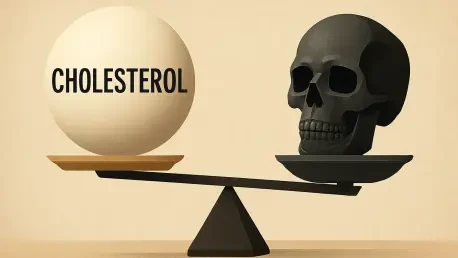

The standard medical narrative has long insisted that lower cholesterol levels are synonymous with better health outcomes, yet recent large-scale data suggests a far more nuanced reality exists for the general population. A comprehensive 2025 study involving nearly half a million participants from both the United Kingdom and China indicates that the relationship between lipid levels and longevity follows a complex dual-risk pattern rather than a simple linear trajectory. This research challenges the traditional “lower is always better” mantra by highlighting that while high cholesterol poses clear cardiovascular threats, excessively low or rapidly declining levels are associated with increased mortality from non-cardiovascular causes like cancer. By examining data from the UK Biobank and major longitudinal cohorts in China, scientists have identified that the stability of these markers over several years is a critical predictor of survival, often overshadowing the importance of a single baseline measurement taken during a routine check-up. This shift in understanding requires a reassessment of how clinicians interpret lipid panels for patients who are not already categorized as high-risk or undergoing intensive pharmaceutical intervention.
Study Design: Analyzing Large-Scale Global Cohorts
The integrity of these findings rests upon an immense data pool drawn from diverse geographical and genetic backgrounds, involving 163,115 Chinese adults and 317,305 individuals from the United Kingdom. Researchers utilized the Dongfeng-Tongji and Kailuan studies alongside the extensive UK Biobank to monitor participants with mean ages ranging from 49 to 61 years. This multi-cohort approach allowed the scientific team to observe trends across different lifestyles and healthcare systems, providing a robust foundation for their conclusions. By moving beyond small-scale clinical trials and focusing on massive prospective longitudinal data, the study successfully captured the long-term health trajectories of a broad demographic. The sheer volume of participants ensured that the statistical power of the results remained high, even when sub-analyzing specific causes of death. This methodology represents a modern shift toward data-driven medicine that prioritizes population-wide observations over narrow, short-term experimental findings.
To maintain the highest level of accuracy and isolate the specific effects of cholesterol, the research team implemented rigorous exclusion criteria that filtered out potential biological noise. Individuals with a pre-existing history of coronary heart disease, stroke, cancer, or chronic obstructive pulmonary disease were removed from the primary analysis to prevent these conditions from skewing mortality data. Furthermore, the scientists excluded any participants who passed away within the first two years of the follow-up period to eliminate the risk of reverse causality. This step was vital because undiagnosed terminal illnesses often cause a natural drop in lipid levels before a patient is officially diagnosed; without this exclusion, low cholesterol might have been incorrectly identified as the cause of death rather than a symptom of an underlying disease. By also omitting individuals already taking lipid-lowering medications or those with a very low body mass index, the study focused purely on the natural biological relationship between cholesterol and longevity in a healthy population.
Baseline Metrics: The Dual-Risk Pattern of Lipids
The investigation revealed a distinct U-shaped or J-shaped risk curve, suggesting that health risks escalate at both the high and low ends of the cholesterol spectrum. While high concentrations of Total Cholesterol, Low-Density Lipoprotein, and non-High-Density Lipoprotein were strongly associated with an increased risk of mortality from coronary heart disease, a surprising trend emerged at the lower end of the scale. Participants with significantly low cholesterol readings faced a heightened risk of all-cause mortality and cancer-related deaths, contradicting the assumption that lower levels are universally protective. This suggests that while maintaining low lipids is beneficial for the heart, pushing levels below a certain physiological threshold may indicate or contribute to other systemic vulnerabilities. The data implies that cholesterol plays a vital role in cellular maintenance and immune function, which could explain why excessively low levels correlate with higher non-cardiovascular mortality rates across different populations.
For individuals not currently managed by medication, the study identified specific optimal targets that minimize the risk of all-cause mortality while maintaining heart health. In the Chinese cohorts, these ideal benchmarks were established at approximately 200 mg/dL for Total Cholesterol and 130 mg/dL for Low-Density Lipoprotein. These figures are remarkably consistent with long-standing clinical guidelines but add a new layer of interpretation by framing them as a “sweet spot” for overall longevity rather than just a ceiling to stay under. By establishing these targets, the research provides a clear roadmap for what constitutes a healthy metabolic profile in the general public. It reinforces the idea that biological systems function best within a balanced range, where there is enough cholesterol to support vital functions but not so much that it causes arterial damage. This balanced perspective encourages a more holistic view of metabolic health that values physiological stability over reaching the lowest possible numerical values on a lab report.
Metabolic Stability: The Significance of Longitudinal Changes
A pivotal component of this research involved tracking how cholesterol levels fluctuated over a four-year period, revealing that the direction of change is just as important as the initial starting point. The data demonstrated that metabolic stability serves as a primary indicator of long-term health, as participants whose lipid levels remained consistent over time experienced the lowest overall mortality risks. This finding suggests that the body’s ability to maintain homeostasis is a marker of underlying physiological resilience. In contrast, significant variations in cholesterol, whether upward or downward, often signaled an increased risk of adverse outcomes. For clinicians, this highlights the necessity of reviewing historical lab results rather than relying on a single “snapshot” in time. If a patient’s lipid profile remains stable within a moderate range, their long-term prognosis appears significantly better than those whose numbers show high volatility, regardless of where they fall on the standard reference scale.
One of the most concerning discoveries was the link between a sharp, unintentional decline in cholesterol and a marked increase in the risk of death. Participants who saw their lipid levels drop by more than 20% over a four-year window faced a 14% to 26% higher risk of all-cause mortality compared to those with stable profiles. This phenomenon occurred in individuals who were not taking statins or other lipid-lowering drugs, suggesting that the drop was a biological response rather than a therapeutic success. Such a rapid decrease serves as a significant clinical “red flag” that may point toward undiagnosed chronic conditions, wasting diseases, or early-stage malignancies. Instead of celebrating a spontaneous drop in cholesterol, healthcare providers should view these changes as a prompt for deeper diagnostic investigation. This perspective shifts the focus from treating a number to treating the whole patient, recognizing that sudden metabolic shifts are often the first signs of systemic failure or serious hidden illness.
Statistical Integrity: Adjusting for Confounding Health Factors
To ensure that the observed relationships were truly driven by cholesterol and not by external influences, the researchers utilized sophisticated Cox proportional hazards models for their analysis. This statistical approach allowed the team to adjust for a wide array of demographic variables, including age, gender, and education levels, which often correlate with health outcomes. By neutralizing these factors, the study isolated the impact of cholesterol levels across different societal groups, ensuring the findings were universally applicable. The precision of these models provided a high degree of confidence that the U-shaped risk curve was an independent biological reality rather than a byproduct of socioeconomic status or age-related decline. This level of rigor is essential in modern epidemiological research, as it prevents the misidentification of secondary correlations as primary causes. The resulting data offers a clear and unobstructed view of how lipid profiles directly influence the timeline of human mortality.
The analysis further refined its conclusions by accounting for lifestyle choices and physical health markers that traditionally impact cardiovascular and metabolic health. Variables such as smoking status, alcohol consumption, physical activity levels, and body mass index were all integrated into the hazard models to prevent them from distorting the results. Additionally, the researchers adjusted for the history of hypertension and diabetes, ensuring that the mortality risks attributed to cholesterol were not actually the result of these common comorbidities. This comprehensive adjustment process confirmed that both excessively high and rapidly falling cholesterol levels are independent risk factors for death. By stripping away the influence of other chronic conditions and lifestyle habits, the study proved that the stability and range of lipids have a unique and profound effect on longevity. This evidence-based approach provides a solid foundation for developing more targeted health interventions that prioritize metabolic consistency over simple reduction.
Clinical Practice: Shifting Toward Individualized Risk Assessment
The results of this extensive study suggested that the future of lipid management must prioritize an individualized approach that considers a patient’s historical trends. It was determined that for the healthy general population, maintaining a stable and moderate cholesterol profile offered the most reliable protection against all-cause mortality. This approach moved away from the “one size fits all” strategy of aggressive reduction, emphasizing instead that the body functions optimally within a specific biological window. Practitioners were encouraged to look for metabolic consistency, viewing a steady LDL level of 130 mg/dL as a positive indicator of health rather than a target for further reduction. By recognizing that extremely low cholesterol can be as detrimental as high cholesterol, the medical community gained a more balanced perspective on human biology. This shift promoted a more conservative but vigilant monitoring strategy for patients who do not display high cardiovascular risks.
Future health strategies began to incorporate longitudinal tracking as a standard component of preventative care, focusing on identifying metabolic volatility early. It became clear that a 20% drop in cholesterol in an untreated patient required immediate clinical attention to rule out underlying pathologies. This proactive stance allowed for earlier detection of various conditions that might have otherwise remained hidden until they reached advanced stages. By integrating historical data into current diagnostic frameworks, clinicians improved their ability to predict mortality risks with greater accuracy. The study ultimately provided the tools necessary to move beyond static lab results and toward a dynamic understanding of health. This evolution in medical thinking ensured that lipid management became a sophisticated part of overall wellness, prioritizing long-term stability and the detection of subtle biological shifts to extend human life expectancy through more informed and personalized healthcare decisions.