
Ivan Kairatov is a leading figure in the biopharmaceutical landscape, recognized for his extensive contributions to the research and development of implantable medical technologies. With a career spanning the intersection of materials science and biotechnology, he has dedicated his expertise to overcoming the physiological barriers that prevent lab-engineered cells from functioning effectively inside the human body. Kairatov’s work focuses on creating “living pharmacies”—devices capable of producing and delivering therapeutic proteins directly within a patient’s tissue. In this discussion, we explore the breakthrough HOBIT system, a hybrid bioelectronic platform designed to sustain high-density cell populations in the low-oxygen environment beneath the skin, potentially transforming how we treat chronic diseases like diabetes and hormonal deficiencies.
The following conversation delves into the technical hurdles of subcutaneous implantation, the mechanics of in-situ oxygen generation, and the sophisticated multi-stage encapsulation strategies required to shield therapeutic cells from the host’s immune system.
Subcutaneous implants face harsh, low-oxygen environments that limit cell survival and productivity. How does utilizing an iridium oxide-based oxygenator solve this specific bottleneck, and what technical steps ensure that splitting water into oxygen doesn’t produce toxic byproducts that could harm neighboring tissue?
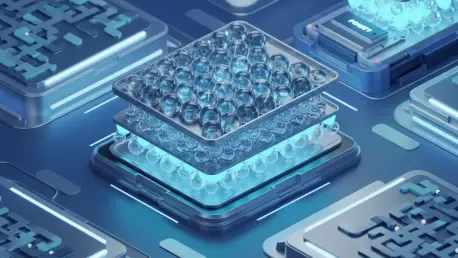
The primary challenge of the subcutaneous space is that it is significantly less vascularized than internal organs, meaning cells packed into a device quickly suffocate as they compete for a limited local supply. To solve this, we integrated an iridium oxide-based electrocatalytic oxygenator that essentially acts as a localized oxygen factory. By using an on-board battery to provide a precise electrical current, the device splits the water molecules naturally present in the surrounding tissue into pure oxygen directly where the cells reside. We have carefully engineered the electrochemical parameters to ensure this process remains clean and efficient, preventing the formation of harmful reactive species or toxic byproducts. This localized production ensures that even in a “biological desert,” the cells have the constant 24/7 respiratory support they need to remain metabolically active and productive.
Achieving high cell densities is vital for therapeutic dosing in gum-sized devices. Can you explain the design trade-offs involved in reaching six times the standard cell density, and how do the integrated wireless electronics allow for the remote modulation of this internal environment?
In traditional unoxygenated implants, you are forced to keep cell density very low—often spread out in thin layers—to prevent the core of the cluster from dying, but this results in a device too large for practical human use. By integrating active oxygenation, we were able to increase cell density to roughly six times the levels seen in conventional approaches, allowing us to fit a clinically meaningful dose into a package the size of a folded stick of gum. The trade-off is the need for sophisticated power management and electronic control within that small volume. Our system features fully integrated wireless electronics that allow researchers or clinicians to remotely adjust the rate of oxygen production. This means we can tune the internal environment in real-time to match the metabolic demands of the cells without needing any invasive wires protruding through the skin.
Protecting cells from the immune system while allowing biologics to flow freely requires a delicate balance. What specific advantages does a two-stage encapsulation approach using alginate beads and semipermeable membranes offer, and how does this double barrier impact the secretion rates of complex molecules?
The two-stage encapsulation is our primary defense strategy against the host’s immune system, which would otherwise quickly destroy the foreign “factory” cells. First, we microencapsulate the engineered cells into alginate hydrogel beads, which provide a gentle, biocompatible immediate environment that mimics the natural extracellular matrix. These beads are then loaded into a larger chamber shielded by a high-tech semipermeable membrane that acts as a physical wall against immune cells and large antibodies. Despite this double-layered defense, we’ve optimized the porosity to ensure that smaller therapeutic molecules—like hormones or GLP-1 analogs—can still diffuse out into the patient’s bloodstream unimpeded. This architecture provides the necessary ruggedness for long-term implantation while maintaining the high secretion rates required for effective therapy.
Engineering a single platform to produce antibodies, hormones, and GLP-1-like molecules simultaneously is a complex task. How do you tailor the cell chamber for these diverse therapeutic classes, and what unique challenges do you anticipate when transitioning this technology to manage high-demand cells like pancreatic islets?
The HOBIT platform serves as a versatile proof of concept where we’ve successfully demonstrated that a single device can house “cell factories” producing three distinct classes of biologics: an antibody, a hormone, and an exenatide. Each of these has a different molecular weight and biological half-life, requiring a chamber that is “tuned” to allow diverse molecules to exit at their required therapeutic rates. When we look toward the future, such as treating diabetes with pancreatic islets, the stakes become even higher because those cells are notoriously oxygen-hungry and sensitive to fluctuations. The challenge there will be the “variable demand” problem; unlike a steady-state hormone pump, islets need to react to glucose spikes, which may require our electronic oxygenator to ramp up production dynamically. We are currently refining the engineering framework to ensure the chamber can handle those higher metabolic loads without compromising the delicate balance of the encapsulation layers.
Long-term viability often drops significantly in unoxygenated implants, yet oxygenated systems show much higher survival rates over 30 days. What specific physiological metrics indicate the system is ready for larger animal trials, and what mechanical adjustments are necessary to sustain these levels for years?
Our 30-day rat studies provided clear evidence of success: roughly 65% of the cells in our oxygenated HOBIT devices remained viable, whereas only about 20% survived in the unoxygenated controls. More importantly, we measured sustained levels of all three therapeutic biologics in the blood of the animals throughout the entire month, while molecules in the control group became undetectable as early as day seven. To move toward larger animal trials and eventually human use, we are looking at metrics like stable oxygen partial pressure and long-term membrane integrity to ensure no “biofouling” or scarring blocks the flow of nutrients. For a system to last for years, we will need to focus on battery longevity or transcutaneous inductive charging and ensure the iridium oxide catalyst remains stable over millions of cycles. These mechanical refinements are the bridge between a successful month-long study and a permanent “set-it-and-forget-it” therapeutic implant.
What is your forecast for the future of implantable cell factories?
I believe we are entering an era where we move away from the burden of daily injections and toward “autonomous” internal medicine. In the next decade, I forecast that these implantable factories will become fully closed-loop systems, where onboard sensors detect a physiological need—like a rise in blood sugar or a drop in a specific hormone—and signal the bioelectronic unit to stimulate the cells to produce the exact dose required. We will see the HOBIT platform evolve into a modular “biologic hub” that can be easily retrieved and swapped, effectively turning chronic disease management into a simple, biannual outpatient procedure. By merging the precision of microelectronics with the raw productive power of living cells, we are creating a future where the pharmacy isn’t a building you visit, but a tiny, smart device that lives and works inside you.