
Imagine a world where the intricate dance of molecules within the brain can be captured in stunning detail, offering a roadmap to tackle one of neurology’s most persistent challenges—epilepsy. This vision is becoming reality thanks to cryo-electron microscopy (Cryo-EM), a cutting-edge technology that has transformed how researchers visualize the microscopic structures implicated in seizure disorders. As a tool that peers into the near-atomic level of proteins like synaptic vesicle glycoprotein 2A (SV2A), Cryo-EM is paving the way for groundbreaking insights into drug interactions and therapeutic possibilities. This review delves into the capabilities of this remarkable technology, exploring its role in advancing epilepsy research and its potential to shape the future of treatment.
Understanding the Power of Cryo-EM Technology
At its core, Cryo-EM represents a leap forward in structural biology, allowing scientists to freeze biological samples in vitreous ice and image them with electron beams to achieve unprecedented resolution. Unlike traditional methods that often distort delicate molecular structures during preparation, this technique preserves proteins in their native state, offering a clearer window into their form and function. Its significance in neuroscience, particularly for epilepsy studies, lies in its ability to reveal the detailed architecture of critical targets like SV2A, a protein central to anti-seizure drug mechanisms.
The emergence of Cryo-EM as a pivotal tool stems from its adaptability across various biological contexts, combined with continuous improvements in imaging and computational power. This technology has shifted from a niche method to a cornerstone of research, enabling a deeper exploration of how drugs bind to specific sites on neuronal proteins. As epilepsy affects millions worldwide, the precision offered by Cryo-EM is not just a scientific luxury—it’s a necessity for designing more effective therapies.
Diving into Cryo-EM’s Key Features and Performance
Mastering Sample Preparation and Freezing
One of the standout aspects of Cryo-EM is its meticulous sample preparation process, which is crucial for high-quality results. Rapid freezing techniques lock biological molecules into vitreous ice, a glass-like state that prevents structural damage from ice crystal formation. This step ensures that proteins like SV2A remain as close to their natural configuration as possible, a vital factor when studying their interactions with anti-epilepsy drugs.
Moreover, the freezing process minimizes artifacts that could skew imaging outcomes, providing a reliable foundation for detailed analysis. This precision is particularly relevant in epilepsy research, where even subtle conformational changes in a protein can influence drug efficacy. The ability to preserve such delicate structures positions Cryo-EM as an indispensable asset in uncovering molecular truths.
Precision Imaging and Advanced Data Analysis
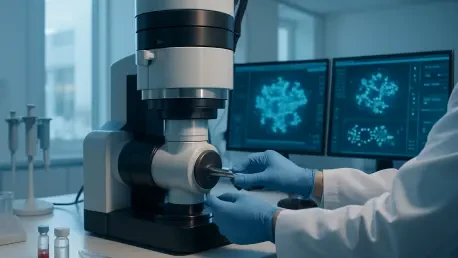
Beyond preparation, the imaging capabilities of Cryo-EM are nothing short of remarkable, driven by sophisticated electron beam technology paired with cutting-edge detectors. These components capture images at resolutions that reveal the intricate details of drug-protein binding sites, such as those on SV2A targeted by medications like levetiracetam and brivaracetam. Such clarity allows researchers to observe how these drugs induce specific structural shifts, informing the design of more potent compounds.
Equally impressive is the role of data processing in translating raw images into meaningful 3D models. Advanced algorithms stitch together thousands of images, reconstructing molecular structures with pinpoint accuracy. This computational prowess not only enhances the understanding of current drug interactions but also highlights potential allosteric sites for future therapeutic targeting, marking Cryo-EM as a game-changer in structural pharmacology.
Breakthroughs and Real-World Impact in Epilepsy Studies
Recent advancements in Cryo-EM have further solidified its importance, with innovations in detector sensitivity and automated data collection streamlining the research process. These developments reduce the time and effort needed to achieve high-resolution images, accelerating discoveries related to epilepsy. The growing trend of integrating Cryo-EM with structural pharmacology is particularly exciting, as it focuses on crafting drugs that precisely target specific protein sites for maximum impact with minimal side effects.
In practical terms, Cryo-EM has already delivered transformative insights by mapping how drugs like padsevonil interact with both primary and allosteric sites on SV2A, revealing opportunities for optimizing therapeutic outcomes. This dual-binding approach, distinct from the single-site binding of other medications, showcases the technology’s ability to uncover nuanced mechanisms. Such findings are driving a wave of interest in designing more tailored anti-epilepsy treatments that could significantly improve patient quality of life.
Navigating Challenges and Limitations
Despite its promise, Cryo-EM is not without hurdles that temper its widespread adoption in epilepsy research. Technical challenges, such as managing sample heterogeneity, often complicate the imaging process, while the high cost of equipment and maintenance poses a barrier to many institutions. These obstacles highlight the need for continued innovation to make the technology more accessible to a broader scientific community.
Additionally, even with detailed structural data, gaps remain in understanding the full biological role of proteins like SV2A, limiting the ability to translate findings into functional insights. Efforts are underway to refine interpretive methods and integrate Cryo-EM with complementary approaches, aiming to bridge these knowledge gaps. Overcoming such limitations will be crucial to fully harnessing the technology’s potential in therapeutic development.
Looking Ahead: The Future of Cryo-EM in Epilepsy Treatment
The trajectory of Cryo-EM suggests a future rich with possibility, particularly in resolving even finer molecular details that could unlock new dimensions of drug design. Integration with emerging tools like artificial intelligence promises to enhance predictive modeling of drug-protein interactions, potentially speeding up the creation of highly specific anti-epilepsy therapies. This synergy could redefine how treatments are conceptualized and tested over the coming years.
Furthermore, as accessibility improves, Cryo-EM is likely to become a staple in collaborative research efforts, fostering a deeper collective understanding of epilepsy’s molecular underpinnings. The focus from now to the next few years will likely center on leveraging these advancements to target elusive allosteric sites, paving the way for therapies that are both more effective and less prone to side effects. This forward momentum underscores the technology’s evolving role in neuroscience.
Final Thoughts on a Transformative Tool
Reflecting on the journey, Cryo-EM proved to be a catalyst for profound discoveries in epilepsy research, illuminating the structural intricacies of vital proteins and their drug interactions. Its capacity to capture near-atomic details opened doors to insights that were once out of reach. The technology’s impact was evident in how it reshaped the approach to therapeutic optimization, offering a clearer path toward specificity.
Looking back, the next steps centered on broadening access to this powerful tool while integrating it with innovative methodologies to address lingering biological mysteries. Collaborative efforts were poised to play a key role, ensuring that the benefits of Cryo-EM reached diverse research communities. Ultimately, the focus remained on translating these structural revelations into tangible, life-changing treatments for those battling epilepsy.