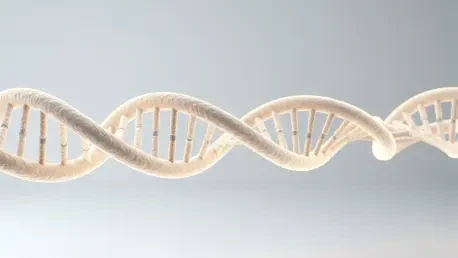

Within the microscopic confines of a cell’s nucleus, the two-meter-long strand of human DNA is not merely a static blueprint but a dynamic, physically active entity, a revelation that is reshaping our fundamental understanding of biology. Recent research has uncovered a previously unappreciated layer of genetic control, demonstrating that the physical twisting and coiling of the DNA molecule itself is a critical mechanism through which cells respond to hormonal signals. This discovery, centered on the hormone estrogen, establishes that the topology of our genome—its shape and tension—is not a passive byproduct of cellular activity but a deliberately orchestrated process. This insight into the mechanical language of our cells is providing a profound new perspective on gene regulation and opening promising avenues for developing more sophisticated and effective cancer therapies.
Unraveling a New Layer of Genetic Control
The Dynamic Dance of Hormones and Enzymes
For years, a central question in molecular biology has been how a single signal, such as the hormone estrogen, can orchestrate the precise activation and deactivation of hundreds of different genes, each playing a unique role in processes ranging from cell growth and metabolism to reproduction. The answer now appears to lie not just in chemical interactions but in the physical mechanics of the genome itself. Groundbreaking research has identified enzymes known as topoisomerases as the master conductors of this genetic symphony. When a cell detects the presence of estrogen, these enzymes spring into action, not merely as passive maintenance workers, but as active manipulators of the DNA strand. They intentionally generate and modulate physical tension, twisting and coiling specific regions of the genome. This action effectively translates a chemical message—the presence of estrogen—into a physical change that directly influences which genes are expressed, providing a sophisticated mechanism for widespread and coordinated genetic control.
This finding fundamentally redefines the long-held view of topoisomerases. Previously, these enzymes were primarily understood to function as cellular stress-relievers, their main job being to untangle and relax the DNA double helix as it becomes overwound during essential processes like replication and transcription. This was considered a passive, housekeeping role, crucial for preventing the genetic code from becoming hopelessly knotted. However, the new evidence paints a far more active and regulatory picture. In response to a hormonal command, topoisomerases are not just resolving tension; they are strategically creating it. This induced torsional stress is a key tool the cell uses to reconfigure the three-dimensional architecture of the genome, demonstrating that these enzymes are at the heart of a complex, dynamic system of gene regulation that relies on the physical properties of the DNA molecule itself.
Supercoiling as DNA’s Physical Language
The human genome’s functionality is deeply encoded in its three-dimensional structure. To fit inside the nucleus, the long DNA strand is meticulously folded in a non-random, highly organized manner that allows linearly distant regions to come into close physical contact. These contact points between regulatory elements like gene promoters and enhancers are essential for triggering gene activity. The recent study builds upon this concept by introducing what could be considered a fourth dimension: dynamic, real-time changes in the DNA’s physical tension. The specific mechanism orchestrated by topoisomerases is known as DNA supercoiling, a phenomenon where the double helix twists upon itself, much like a coiled telephone cord. The research proves that these alterations in supercoiling are not a random consequence of cellular processes but a deliberate and precise signaling mechanism used to fine-tune the expression of specific, estrogen-responsive genes.
This induced tension serves as a powerful regulatory tool by altering the folding patterns of chromatin, the complex of DNA and proteins that forms chromosomes. By strategically increasing or decreasing supercoiling in specific genomic locations, the cell can control which regulatory regions make contact with each other, thereby activating a select set of genes while leaving others dormant. In this intricate system, estrogen acts as the initial signal, topoisomerases function as the molecular machinery that executes the command, and the resulting supercoiling is the physical mechanism that ultimately determines the cell’s genetic response. This model reveals that the cell actively generates and modulates these physical forces to promote the specific genomic contacts needed to stimulate a coordinated wave of gene activation, adding a crucial mechanical layer to our understanding of cellular communication.
A New Blueprint for Oncology
Connecting Disparate Pathways in Cancer Therapy
The implications of this new understanding of DNA topology extend directly into the field of oncology, particularly in the treatment of hormone-dependent cancers. Many forms of breast cancer, for example, are estrogen-receptor-positive, meaning their growth and proliferation are fueled by the presence of estrogen. Consequently, two of the most important pillars of treatment for these cancers have been hormone therapy, which works by blocking the estrogen signal to starve cancer cells, and a class of chemotherapy drugs known as topoisomerase inhibitors, which disrupt the function of these enzymes, leading to DNA damage and cell death. For decades, these two therapeutic approaches were viewed as targeting completely independent cellular pathways—one chemical and one mechanical. They were prescribed and studied based on the assumption that they fought cancer through distinct, unrelated mechanisms of action.
This long-standing paradigm has been shattered by the revelation that these two pathways are not just connected but are functionally inseparable. The way a cell responds to estrogen, the target of hormone therapy, is now understood to be directly dependent on the precise actions of topoisomerases, the target of a major class of chemotherapy. This discovery establishes a direct biological link between a hormonal signal and the physical machinery that reshapes the genome in response to it. This unified perspective provides a more holistic and accurate model of cellular function, suggesting that the effectiveness of one treatment may inherently influence the cell’s sensitivity to the other. It forces a re-evaluation of how these cornerstone therapies function, both alone and in combination, and offers a more integrated framework for understanding the complex biology of hormone-driven cancers.
Redefining Treatment Resistance and Future Strategy
This newfound link offers a compelling molecular explanation for one of the most significant challenges in cancer treatment: acquired resistance. It is a common and devastating clinical scenario for a tumor that initially responds well to hormone therapy to eventually stop responding and resume its growth. The discovery of DNA topology as a key regulator suggests a potential mechanism for this phenomenon. A cancer cell could, for instance, develop mutations or alter its internal signaling pathways in a way that allows it to regulate its DNA supercoiling independently of the estrogen signal. By finding an alternative way to activate the necessary growth-promoting genes through topological changes, the tumor could effectively bypass its dependency on the hormone, rendering hormone-blocking therapies ineffective. This provides a tangible biological basis for resistance and points toward new diagnostic and therapeutic targets.
The knowledge that hormonal signaling and DNA topology are functionally intertwined provided researchers with a new blueprint for designing more rational and personalized therapeutic strategies. This deeper understanding of the underlying biology created opportunities to explore novel combination therapies that could more effectively combat cancer and preempt the development of resistance. The research laid the groundwork for investigating synergistic drug pairings that could simultaneously target both the estrogen receptor and the topoisomerase enzymes. By attacking both the signaling pathway and the mechanical response it triggers, such combination treatments held the potential to create a more robust and durable anti-cancer effect. The study ultimately delivered a critical shift in perspective, offering a crucial bridge between two key areas of cancer treatment that could lead to more effective therapies against hormone-dependent cancers.