
Within the microscopic universe of a single human cell lies a communication network of staggering complexity, where molecules constantly send and receive signals to orchestrate life’s essential functions. When this intricate dialogue breaks down, the consequences can be catastrophic, leading to uncontrolled cell growth and the development of cancer. For decades, scientists have grappled with the monumental task of eavesdropping on these cellular conversations to understand what goes wrong, but the sheer volume of interactions and the background noise of false signals have made it akin to isolating a single whisper in a crowded stadium. The challenge is not just identifying individual genetic culprits but mapping the entire web of dysfunctional relationships that drive a tumor’s growth and resilience, a task that has long pushed the boundaries of biological research and computational power.
A New Era of Genomic Cartography
Bridging Data Science and Oncology
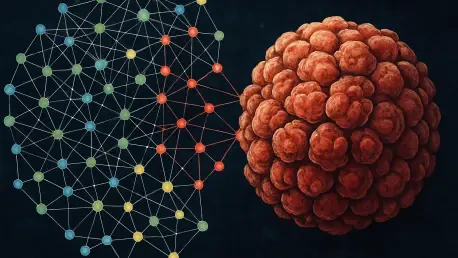
Researchers have now introduced RNACOREX, a sophisticated open-source software tool designed to meticulously chart the gene regulation networks that fuel cancerous growth. Developed through a collaboration between data scientists and oncologists at the University of Navarra, this tool addresses the critical challenge of deciphering the complex interplay between different types of RNA molecules. At its core, RNACOREX integrates vast amounts of information from major international genomic databases with the direct analysis of gene-expression data from actual tumor samples. By simultaneously examining thousands of molecules, specifically microRNAs (miRNAs) and messenger RNAs (mRNAs), it can systematically rank their interactions based on biological relevance. This allows the software to filter out statistical noise and detect crucial regulatory connections that conventional analytical methods might overlook. The result is an interpretable molecular map, a clear and detailed schematic of the gene networks that have gone awry, which can be built into increasingly complex regulatory models that also serve as powerful probabilistic tools for further analysis.
The Power of Explainable AI
To rigorously validate its capabilities, RNACOREX was tested on extensive datasets from The Cancer Genome Atlas (TCGA), a large-scale international consortium. The analysis spanned thirteen distinct and aggressive tumor types, including breast, colon, lung, and melanoma, providing a robust and diverse testing ground. The results demonstrated that the software could predict patient survival outcomes with an accuracy comparable to that of highly complex “black-box” artificial intelligence models. However, RNACOREX offers a crucial advantage that sets it apart: interpretability. Unlike many advanced AI systems that provide predictions without revealing their underlying logic, this tool delivers clear, explainable insights into the specific molecular interactions that form the basis of its conclusions. This transparency is invaluable for researchers, as it transforms the predictive model from an opaque oracle into an investigative partner. By understanding the “why” behind a prediction, scientists can formulate new hypotheses, design targeted experiments, and gain a deeper biological understanding of the disease, positioning the tool as a transparent and powerful alternative in the rapidly advancing field of AI in genomics.
From Discovery to Practical Application
Uncovering Shared Patterns and Future Targets
The utility of RNACOREX extends far beyond clinical outcome prediction, opening new avenues for fundamental cancer research. One of its most significant findings is the ability to uncover shared molecular patterns and regulatory networks that are common across different types of cancer. This discovery suggests that despite their diverse origins and clinical presentations, many tumors may rely on similar underlying mechanisms for their growth and survival. By identifying these common vulnerabilities, the software provides a roadmap for developing therapies that could be effective against a broader range of cancers. Furthermore, the tool excels at pinpointing specific molecules of high biomedical interest that act as key nodes within these dysfunctional networks. This capability allows researchers to move from a vast sea of genomic data to a manageable list of high-priority targets, generating valuable clues and testable hypotheses about the mechanisms driving tumor progression. Ultimately, this accelerates the search for novel biomarkers for early diagnosis and innovative targets for next-generation therapeutic interventions.
Charting a Path Forward in Precision Medicine
The development of RNACOREX marked a significant step in making advanced genomic analysis more accessible and actionable for the global research community. As an open-source tool publicly available on platforms like GitHub and the Python Package Index (PyPI), it was designed for broad adoption, incorporating features like automated database downloads to streamline its implementation in diverse laboratory settings. The commitment to its ongoing development included plans to integrate new functionalities, such as pathway analysis and the inclusion of additional molecular interaction layers. These enhancements aimed to construct even more comprehensive and multi-faceted models of tumor biology. This project epitomized a successful interdisciplinary approach, merging the frontiers of biomedicine, data science, and artificial intelligence. By providing a clear, network-based view of cancer, this work laid a crucial foundation that helped advance the ambitious goal of personalized and precision medicine, offering a more detailed map to guide future exploration and treatment strategies.