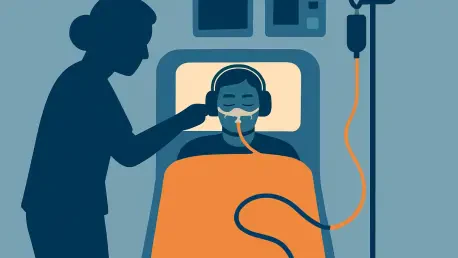

In operating rooms where silence often amplifies stress, a small change—a pair of headphones and a vigilant recovery plan—can shift the arc of the first hours after colorectal cancer surgery, easing the path from anesthesia to wakefulness while trimming complications that make families and clinicians hold their breath. This research summary examines whether adding soothing music and a structured anesthesia recovery care bundle to standard perioperative nursing meaningfully improves immediate postoperative recovery for adults undergoing laparoscopic radical resection for colorectal cancer.
Framing the question and study focus
At the heart of this investigation sits a practical question with high clinical stakes: do calming music and targeted recovery care, layered onto standard nursing, smooth the emergence from anesthesia and improve short-term recovery after laparoscopic surgery for colorectal cancer? The study probes the moments when patients transition from unconsciousness to awareness—often the most unstable phase—where spikes in heart rate and blood pressure, agitation, and shivering can derail an otherwise well-run procedure.
Standard nursing protocols reduce risk, yet they do not always prevent the turbulence of emergence. The analysis centers on a retrospective single-center cohort of 120 adults. One group received established perioperative care, while the other received the same plus twice-daily music therapy and a structured anesthesia recovery protocol. The work homes in on time to consciousness, extubation, and discharge from the post-anesthesia care unit; hemodynamics during emergence; neuroendocrine stress markers; functional recovery measured by the Postoperative Quality of Recovery Scale; and immediate complications, including hypothermia, shivering, nausea, vomiting, and agitation.
Background and significance
Colorectal cancer remains a major global burden, and laparoscopic radical resection is widely adopted because it reduces trauma and hastens convalescence compared with open surgery. Even so, general anesthesia can trigger sympathetic surges and erratic physiology as patients wake. That instability undermines comfort, heightens risk, and can prolong time spent in recovery. Nurses and anesthesiologists anticipate those swings, but routine measures may not fully forestall them.
This is where two nonpharmacologic strategies offer promise. Music therapy can ease anxiety, modulate sympathetic tone, and support comfort through a simple, low-risk intervention. Structured anesthesia recovery care—proactive thermal management, vigilant airway oversight, optimal positioning, and individualized sedation and analgesia—targets the specific complications that cluster around emergence. Prior studies have highlighted benefits of each in isolation; testing them together speaks to modern enhanced recovery principles and the push toward value-based care that rewards safety, efficiency, and patient experience.
Research methodology, findings, and implications
Methodology
The study draws on a retrospective analysis conducted from January 2022 to May 2024 at a single hospital. Adults with confirmed colorectal cancer scheduled for elective laparoscopic radical resection were screened under strict inclusion and exclusion criteria to ensure medical suitability and intact cognition and sensory function. The final sample included 120 patients with comparable baseline traits across groups, including age, sex, body mass index, anesthesia duration, and tumor stage, reducing confounding from demographic or disease-related differences.
All participants received the same anesthetic regimen and were operated on by the same surgical team to limit variability unrelated to the interventions. The control group had standard perioperative nursing—preoperative education, fasting guidance, routine tube placement, standardized induction, and continuous intraoperative monitoring. The observation group had those elements plus twice-daily calming, professionally curated music at low volume and a comprehensive recovery bundle focused on reassurance, active warming with warmed fluids and intraoperative temperature management, careful positioning, continuous airway monitoring, and tailored sedation and analgesia aimed at curbing agitation without slowing wakefulness.
Outcome measures captured multiple layers of recovery. Time-based metrics tracked consciousness, extubation, and length of stay in the post-anesthesia care unit. Hemodynamic data indexed stability during emergence. Neuroendocrine stress responses were quantified through cortisol, aldosterone, norepinephrine, and adrenaline. Functional recovery was assessed with the Postoperative Quality of Recovery Scale across cognitive, emotional, daily living, nociceptive, and physiological domains. The team also examined immediate complications, with between-group comparisons interpreted in light of the retrospective design’s constraints on causal inference.
Findings
Patients exposed to both music and structured recovery care woke faster, were extubated earlier, and left the post-anesthesia care unit sooner than those with standard care alone. These gains suggest more efficient throughput and smoother transitions, the kind of differences that patients feel and clinicians notice during busy recovery shifts. Faster emergence times did not come at the cost of safety; rather, they aligned with better physiologic control.
Hemodynamic patterns during emergence told a similar story. Heart rate and blood pressure rose in both groups when anesthesia lightened, as expected, but those increases were smaller and more controlled with the combined intervention. The physiologic signature of the stress response was likewise blunted: postoperative surges in cortisol, aldosterone, norepinephrine, and adrenaline were lower in the intervention group, signaling dampened sympathetic activation when it matters most.
Importantly, benefits extended beyond monitors and lab draws. Functional recovery scores were higher across all Postoperative Quality of Recovery Scale domains among patients who received music and structured care, indicating that cognition, mood, daily functioning, and nociception recovered more fully in the immediate postoperative period. Complications were also fewer and less severe. Shivering, hypothermia, nausea, vomiting, and emergence agitation clustered in 40% of the control group but in only 10% of the intervention group, a striking difference with clear clinical and operational meaning.
Implications
These results point to practical, low-cost ways to elevate early recovery after laparoscopic colorectal surgery. A curated music protocol and a tightly executed recovery bundle require minimal infrastructure, yet they support safer emergence, reduce complications, and may shorten recovery unit stays. For teams working within enhanced recovery pathways, the interventions fit hand-in-glove with ongoing efforts around warming, airway vigilance, and symptom control.
The mechanistic plausibility adds confidence. Music reduces anxiety and sympathetic outflow, which helps stabilize hemodynamics and stress chemistry. Recovery care directly addresses thermal dysregulation, airway instability, and agitation—frequent triggers for cascading problems after anesthesia. Together, the approaches act synergistically. While these findings come from a single-center, nonrandomized cohort, the coherence across physiologic, biochemical, functional, and complication endpoints strengthens the case for broader testing and careful implementation.
Reflection and future directions
Reflection
Several strengths stand out. The interventions are described in sufficient detail for replication, including the timing and volume of music and the components of the recovery bundle. Surgical and anesthetic approaches were tightly standardized to reduce noise in the signal. Outcome measures spanned objective physiology, biomarkers, patient-reported recovery, and complications, yielding a multidimensional picture consistent with prior literature on music therapy and enhanced recovery practices.
That said, design limitations temper interpretation. Retrospective, single-center analyses carry risks of selection bias and unmeasured confounding, and nonrandomized allocation weakens causal claims. With 120 participants, the study may be underpowered for rare events and subgroup analyses by age, tumor stage, or comorbidity. The focus on immediate postoperative outcomes leaves long-term trajectories—pain, cognition, satisfaction, readmissions, and oncologic endpoints—unaddressed. Music choices and session timing were fixed rather than personalized, and sessions were not synchronized to the exact emergence window, which could matter.
Operationally, the findings highlight the outsized role of proactive thermal and airway management during emergence. Warmed fluids, active warming, and strict airway monitoring appear to be key levers for preventing the hypothermia–shivering–agitation chain. Moreover, tailored sedation and analgesia can quiet agitation without delaying wakefulness when dosed and timed judiciously. These insights lend themselves to checklists, training modules, and simple metrics that can be audited in routine practice.
Future directions
Next steps should prioritize rigor and reach. Prospective randomized trials across multiple centers would clarify causality, test generalizability, and define which patients benefit most. Larger cohorts could support stratified analyses by age, disease stage, and comorbidity burden, as well as exploration of rare adverse events. Factorial designs would help separate the independent and additive effects of music and recovery care and guide resource allocation.
Personalization deserves attention. Allowing patient-selected music, calibrating session length and volume, and aligning playback to the peri-emergence window could amplify benefits. Extending follow-up would reveal whether early advantages translate into sustained gains in cognition, pain control, satisfaction, and resource use. Implementation science studies could codify the bundle into pragmatic protocols with training, adherence tracking, and dashboards that display recovery times, complication rates, and length of stay in real-world settings. Finally, testing in other surgical specialties could broaden impact within enhanced recovery frameworks.
Conclusion and practical takeaways
Pairing soothing music with a structured anesthesia recovery bundle accelerated emergence, stabilized hemodynamics, muted stress hormone surges, improved functional recovery, and reduced immediate complications after laparoscopic colorectal cancer surgery. The combined approach fit smoothly into existing perioperative workflows and relied on tools that hospitals already had. While the retrospective, single-center design limited causal certainty, the multidomain benefits and mechanistic coherence supported cautious adoption with local monitoring. The most actionable next steps were clear: pilot curated music protocols, formalize recovery care bundles with warming and airway checklists, track emergence and complication metrics, and pursue multicenter randomized trials to confirm effects and refine implementation.