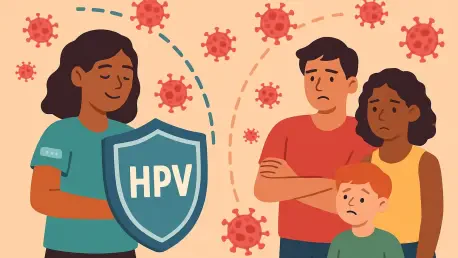

A sweeping nationwide study from Sweden has delivered a definitive answer to one of public health’s most critical questions, demonstrating that high-coverage vaccination programs against the human papillomavirus (HPV) create a powerful shield of protection that extends even to those who have not received the vaccine. By meticulously analyzing the health data of over 850,000 women across different generations, researchers have provided compelling, real-world evidence of a robust “herd effect,” where widespread immunization within a community significantly lowers the risk of serious, precancerous cervical disease for everyone. This landmark investigation moves beyond theoretical models to quantify the community-wide benefits of vaccination, underscoring the profound impact of collective public health initiatives and revealing a crucial threshold that must be met to unlock this protective power. The findings highlight not just the success of a single program but offer a clear, evidence-based blueprint for global strategies aimed at the elimination of cervical cancer.
The Foundation of Community Protection
Human papillomavirus is recognized as the necessary cause of nearly all cervical cancers, establishing vaccination as a primary tool in the global fight against the disease. While the direct effectiveness of HPV vaccines in preventing infection and subsequent cervical lesions in vaccinated individuals is well-established and highly successful, the ultimate goal of public health is to protect the entire population. This broader protection is achieved through herd immunity, a phenomenon that occurs when a substantial portion of a community becomes immune to a disease, making the spread of the virus from person to person unlikely. By reducing the overall circulation of HPV, high vaccination rates indirectly shield individuals who cannot be vaccinated for medical reasons or who otherwise remain unvaccinated. This community-level defense is a cornerstone of modern immunization strategy, aiming to break the chains of transmission and protect the most vulnerable.
Prior research had already indicated that HPV vaccination programs could successfully generate herd effects, leading to documented reductions in the prevalence of HPV infections and related conditions such as genital warts among both vaccinated and unvaccinated populations. However, a significant gap remained in the scientific understanding of whether this indirect protection extended to the most clinically severe outcomes, namely the high-grade cervical lesions known as HSIL+ and adenocarcinoma in situ. These conditions are the direct precursors to invasive cervical cancer, and confirming a protective herd effect against them is pivotal for accurately assessing the full population-level benefit of vaccination campaigns. A clear understanding of this relationship is essential for refining public health policies and optimizing immunization strategies to maximize their impact on cancer prevention, making this Swedish study a critical piece of the puzzle.
A Meticulous Nationwide Investigation
To bridge this knowledge gap, researchers leveraged Sweden’s comprehensive and interconnected national health registries to conduct a large-scale, population-based cohort study. The investigation included a massive cohort of 857,168 females born between 1985 and 2000 who had not received an HPV vaccination. These individuals were carefully followed over time, with data collection beginning either at age 10 or from January 1, 2006, whichever came later. The follow-up for each participant concluded upon their first HPV vaccination, a diagnosis of HSIL+, emigration from the country, death, or the study’s end on December 31, 2022. This rigorous design ensured that the analysis was strictly limited to the period when these individuals were unvaccinated, providing a clear window into the indirect effects of the surrounding vaccination programs. The use of multiple national databases, including the Total Population Register and the National Cervical Screening Registry, allowed for a highly accurate and detailed analysis.
A key strength of the study was its division of participants into four distinct birth cohorts, each exposed to a different national HPV vaccination strategy with varying levels of vaccine uptake. The first, a reference cohort born from 1985 to 1988, was exposed to an opportunistic vaccination model with very low coverage of approximately 6%, serving as a baseline for comparison. The second cohort, born from 1989 to 1992, was eligible for a subsidized program that achieved moderate coverage of about 25%. A third cohort, born from 1993 to 1998, participated in an organized catch-up program that resulted in a higher coverage rate of around 55%. Finally, the youngest cohort, born from 1999 to 2000, was offered vaccination through a structured, school-based program, which successfully achieved very high coverage of over 80%. This natural experiment provided a unique opportunity to compare the incidence of HSIL+ among unvaccinated women under different community-level immunity scenarios.
The Definitive Role of High Coverage
The study’s findings delivered a clear and powerful message about the importance of vaccination coverage. Over a cumulative 9.47 million person-years of follow-up, during which 42,274 cases of HSIL+ were identified, a significant reduction in risk was observed in only one group. Unvaccinated women in the cohort exposed to the school-based vaccination program, which achieved over 80% coverage, demonstrated a markedly lower incidence of high-grade cervical lesions. The analysis revealed that these women had a 47% lower rate of HSIL+ compared to their counterparts in the reference cohort, which had minimal vaccine coverage. This statistically significant result provides powerful, direct evidence that achieving a very high rate of vaccination is the critical factor in generating a protective herd effect strong enough to prevent the development of precancerous disease in the unvaccinated population. The outcome was not a minor statistical variation but a substantial public health victory.
In stark contrast to the success of the high-coverage program, the cohorts with lower or moderate vaccination rates showed no evidence of a protective herd effect. Unvaccinated women in the groups with 25% and 55% coverage did not experience a reduction in their risk of developing HSIL+. In fact, the data suggested a complex dynamic in these cohorts, with a temporarily elevated risk of lesions at younger ages compared to the reference group. This suggests that moderate levels of vaccine coverage are insufficient to meaningfully disrupt virus transmission and may be associated with other factors, such as changes in healthcare-seeking behaviors or sexual practices within those specific age groups. The central conclusion from this comparison is unequivocal: a critical threshold of vaccine uptake must be surpassed to generate community-wide protection against severe cervical disease. Simply implementing a vaccination program is not enough; achieving widespread participation is essential.
A Clear Mandate for Public Health Strategy
This comprehensive investigation from Sweden furnished compelling evidence that the indirect, protective effects of HPV vaccination against severe cervical disease are fundamentally dependent on achieving very high coverage rates. The strong, statistically significant reduction in HSIL+ among unvaccinated females was only realized in the cohort exposed to a school-based program with over 80% uptake. The absence of a similar benefit in programs with 25% or 55% coverage highlighted a critical threshold for generating meaningful community-level immunity. The authors acknowledged potential limitations that might have influenced the results, including evolving national cervical screening protocols and a shorter follow-up period for the youngest cohort. However, despite these caveats, the overarching conclusion stood firm: high-coverage, school-based immunization programs are a uniquely powerful public health instrument that extends significant protection well beyond the individuals who are vaccinated.
Ultimately, the study’s findings presented a decisive case for policymakers across the globe. The research moved beyond theoretical benefits to offer concrete, population-level data demonstrating the immense value of investing in universal, early, and school-based immunization strategies. By showing that only very high coverage rates could unlock the protective power of herd immunity against precancerous lesions, the study provided a clear roadmap for maximizing the impact of HPV vaccination on cervical cancer prevention. It underscored the idea that vaccination is not merely a personal health choice but a collective action that builds a resilient defense for the entire community. This evidence solidified the argument that aiming for the highest possible vaccine uptake is the most effective path toward the global goal of eliminating cervical cancer as a public health problem.