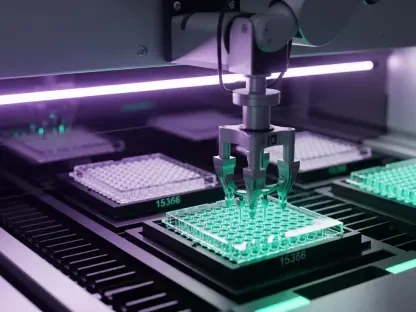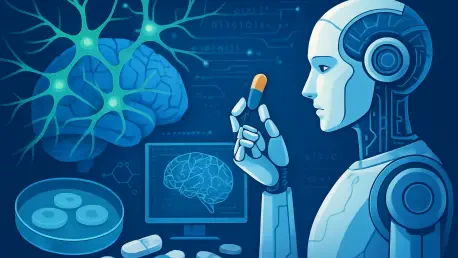

For decades, the path to finding effective treatments for Alzheimer’s disease has been fraught with frustratingly slow progress and a high rate of clinical failures, leaving millions of patients and their families with limited options. This long and challenging journey, however, is now reaching a critical inflection point, as the convergence of biological breakthroughs, massive data initiatives, and sophisticated artificial intelligence is heralding a new era of research. The integration of AI into the drug discovery pipeline is no longer a futuristic concept but a present-day reality, promising to fundamentally reshape how scientists understand, target, and treat this complex neurodegenerative disorder. This technological transformation offers a data-driven approach capable of navigating the immense biological complexity that has long stymied traditional methods, suggesting that the industry is on the cusp of a paradigm shift that could significantly accelerate the development of life-altering therapies.
The Tipping Point Why AI’s Moment is Now
A Convergence of Breakthroughs
The recent surge of optimism in Alzheimer’s research is firmly rooted in tangible clinical progress, which has created the ideal conditions for artificial intelligence to make a significant impact. The landmark FDA approval of two disease-modifying therapies has been a watershed moment, providing definitive proof that the underlying biology of Alzheimer’s can be meaningfully altered. This success did more than just offer new treatment options; it validated specific biological pathways, providing a solid scientific foundation upon which more advanced research can be built. This has renewed confidence throughout the field, shifting the narrative from one of persistent setbacks to one of achievable goals. Simultaneously, the development and increasing accessibility of simple blood-based diagnostic tests are revolutionizing how the disease is identified. These tests are making widespread, early-stage screening a practical reality, which is crucial for identifying patients at a point where therapeutic interventions are most likely to be effective. This confluence of validated biological targets and a new stream of early-stage patient data provides the perfect, high-quality material for AI systems to analyze, learn from, and translate into novel therapeutic strategies.
Coinciding with these clinical advancements has been the rapid maturation of artificial intelligence itself, which has evolved far beyond its initial applications in narrow pattern recognition and simple automation. The technology has progressed into sophisticated, “agentic” systems that demonstrate a capacity for complex reasoning across highly diverse and unstructured datasets. These advanced AI models are no longer just tools for processing information; they can autonomously plan and execute complex analytical workflows, sift through mountains of genomic, proteomic, and clinical data, and, most critically, generate novel and testable hypotheses about the drivers of disease. This leap in capability allows AI to function as a powerful analytical engine, uncovering subtle correlations and intricate biological patterns that are often beyond the scale of human cognitive analysis. For Alzheimer’s research, a field defined by its multifaceted complexity, this ability to synthesize and interpret vast, multimodal information represents a transformative step forward, enabling scientists to ask more profound questions and explore previously inaccessible avenues of discovery.
Building the Data Foundation
The immense promise of artificial intelligence in medical research is entirely contingent upon the availability of massive, well-curated, and standardized datasets, a resource that has historically been a major bottleneck in the Alzheimer’s field. The effectiveness of any AI model is a direct reflection of the quality and breadth of the data it is trained on. Recognizing this critical dependency, a series of concerted global efforts have been launched to overcome this data scarcity. Pioneering initiatives like the Alzheimer’s Disease Data Initiative (ADDI) and its secure, collaborative AD Workbench platform are central to this progress. These platforms are creating cloud-based environments where researchers from around the world can gain access to, share, and analyze harmonized, multimodal data without compromising patient privacy. This infrastructure is essential for breaking down the data silos that have traditionally fragmented research efforts. A prime example of this collaborative success is the Global Neurodegeneration Proteomics Consortium (GNPC), which has successfully built the world’s largest disease-specific proteomics dataset on the AD Workbench, comprising over 250 million protein measurements from more than 35,000 samples. This unprecedented aggregation of high-quality data provides the essential fuel required to train and validate sophisticated AI models, turning a once-unsolvable data challenge into a powerful asset for discovery.
A New Blueprint for Scientific Discovery
From Educated Guesses to Data-Driven Insights
Artificial intelligence is catalyzing a fundamental change in the process of biological discovery, steering the field away from the traditional, sequential, and often slow hypothesis-driven research model. For decades, scientists have typically tested individual assumptions one by one, a methodical but time-consuming process that struggles to account for the intricate web of interactions that characterize complex diseases like Alzheimer’s. In contrast, AI models can analyze large, multimodal datasets in parallel, seamlessly integrating information from genomics, proteomics, medical imaging, and longitudinal clinical records. This holistic approach empowers the technology to identify complex biological patterns, subtle correlations, and potential causal relationships that would otherwise remain hidden within siloed data streams or be too complex for human analysis alone. Instead of relying on educated guesses to formulate a hypothesis, researchers can now leverage AI to surface the most promising biological signals directly from the data, fundamentally changing the starting point of the discovery process.
This shift toward parallel, data-driven analysis directly contributes to the generation of more robust and well-supported biological hypotheses, which is a critical advantage for early-stage drug discovery teams. A significant reason for the high attrition rate in drug development is that many programs are built on foundational science that proves to be flawed or incomplete. By surfacing deeper biological insights and validating potential targets against multiple data modalities, AI helps ensure that the hypotheses moving forward are more likely to be biologically sound. This suggests that AI can help reduce the staggering failure rates in drug development not just by accelerating the speed of target identification, but, more importantly, by improving the quality and reliability of the foundational science upon which these programs are built. This leads to the selection of more viable therapeutic targets from the very beginning, optimizing the allocation of resources and increasing the overall probability of success in bringing a new treatment to patients.
Revolutionizing the Clinical Trial Process
Clinical development for Alzheimer’s therapies has long been hampered by enormous costs, lengthy timelines, and frequent failures, but AI offers the potential for transformative, rather than marginal, improvements in this domain. One of the most persistent challenges in trial design is solving the “Goldilocks problem”—recruiting participants who are at the ideal stage of disease progression, meaning neither too early to show a measurable decline nor too late for a potential treatment to be effective. AI-driven predictive models, by integrating multimodal patient data such as imaging, genetics, and cognitive scores, can generate far more accurate predictions of an individual’s disease trajectory. This predictive power allows for more precise patient stratification and recruitment, ensuring that trial cohorts are more homogeneous and scientifically appropriate for the specific intervention being tested. This precision is key to obtaining clear and statistically significant results, which has been a major hurdle in past trials.
This enhanced precision in patient selection leads directly to more efficient and less burdensome clinical trials. With more accurately defined cohorts, research teams can potentially use smaller groups of participants without sacrificing the statistical power needed to validate a drug’s efficacy. This can lead to faster study readouts, significantly lower costs, and quicker go/no-go decisions, accelerating the entire development timeline. Pushing this concept even further, AI enables the creation of “digital twin” models, which are virtual simulations of disease progression and treatment responses. Using these models, researchers can test various trial designs, dosing strategies, and clinical endpoints in silico before ever enrolling a human participant, helping to de-risk clinical development and optimize protocols. This AI-enabled optimization also improves the experience for patients. Shorter study durations, fewer invasive procedures like lumbar punctures, and the use of digital biomarkers for convenient remote monitoring can significantly reduce the burden on participants and their families, which may in turn lead to more diverse and engaged trial populations.
Navigating the Challenges and Envisioning the Future
The Pillars of Progress Data Diversity and Ethical Responsibility
As artificial intelligence becomes more deeply integrated into the fabric of drug discovery and clinical practice, its effectiveness remains directly tethered to the quality, breadth, and diversity of the data it is trained on. Alzheimer’s is a notoriously heterogeneous disease, with its progression influenced by a complex interplay of genetics, lifestyle, environment, and various comorbidities. To build AI models that are clinically relevant and effective for the broad global patient population, the underlying data must accurately reflect this real-world complexity. This necessitates the careful integration of multiple data modalities, including genomics, proteomics, advanced imaging, digital biomarkers from wearables, and comprehensive longitudinal clinical data. The more diverse and representative the dataset, the more robust and generalizable the AI model will be, reducing the risk of developing therapies that only work for a narrow subset of patients.
Beyond the scientific necessity for diverse data, there is a profound ethical imperative to ensure its equitable application. Training AI models on narrow or homogeneous datasets, such as those drawn from a single ethnicity or geographic location, risks creating biased algorithms. Such models may perform poorly when applied to underrepresented populations, not only failing to provide benefit but also potentially exacerbating existing health disparities. Therefore, ensuring that datasets are representative of the full diversity of people affected by Alzheimer’s is both a scientific requirement for reliability and an ethical obligation. As these powerful tools are deployed, addressing issues of transparency and interpretability is also paramount. “Black-box” AI models, whose internal decision-making processes are opaque, can undermine trust among clinicians, regulators, and patients. For AI-driven insights to be adopted in clinical practice where critical decisions about patient care are made, their reasoning must be understandable, verifiable, and transparent to ensure responsible and trustworthy deployment.
A Transformed Research Landscape
The integration of artificial intelligence into Alzheimer’s research has already initiated a profound transformation, moving the field toward a more collaborative and data-centric future. The vision that has begun to materialize was one where AI evolved beyond being a mere analytical tool to become an active partner in the scientific process. Initiatives designed to develop AI agents capable of reasoning, designing experiments, and proposing novel hypotheses alongside human scientists have pushed the boundaries of what was considered possible. This advanced integration has yielded tangible results, as the first drug candidates and diagnostic tools developed from AI-identified therapeutic targets and biomarkers have started to emerge from discovery pipelines and enter clinical development. The journey from AI-powered insight to tangible clinical application represented a clear and promising new pathway in a field long defined by its immense challenges, offering renewed and concrete hope to millions worldwide affected by this devastating disease.