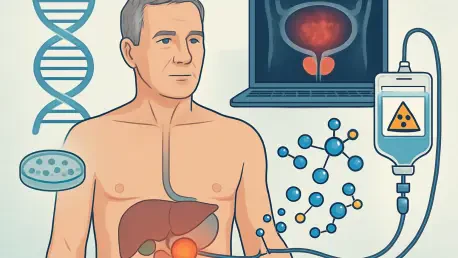

The ability to peer into the biological future of a patient by predicting how a radioactive drug will distribute through their unique anatomy represents a monumental leap in the fight against advanced prostate cancer. The field of oncology is currently navigating a fundamental shift where treatment is no longer dictated solely by the generic type of cancer, but by the highly specific biological signature of the individual. For those battling metastatic castration-resistant prostate cancer, the arrival of radiopharmaceutical therapies has offered a vital lifeline, yet the delivery of these drugs has often relied on broad, retrospective data. We are now entering an era where machine learning can anticipate how a patient will respond to radiation before the first dose ever enters their system, turning a complex medical gamble into a calculated, precision strike.
The integration of artificial intelligence into nuclear medicine provides a bridge between diagnostic insight and therapeutic success. By moving beyond generalized dosing protocols, clinicians can tailor treatments to the specific absorption rates of a patient’s tumors and healthy tissues. This personalized approach not only maximizes the impact of the therapy on malignant cells but also safeguards the patient against the debilitating side effects that often accompany systemic radiation. This evolution marks the transition of “theranostics” from a promising concept into a sophisticated clinical reality that places the individual’s unique physiology at the center of the care plan.
Moving Beyond the “One-Size-Fits-All” Approach in Nuclear Medicine
Modern oncology is undergoing a profound transformation as medical professionals move away from standardized treatment models toward highly individualized care strategies. This shift is particularly evident in the management of advanced prostate cancer, where traditional therapies often hit a ceiling of effectiveness due to the heterogeneous nature of the disease. While radiopharmaceuticals like lutetium-177 have revolutionized the landscape, their administration has historically followed a rigid protocol that treats every patient with a similar baseline. Machine learning changes this dynamic by allowing doctors to visualize the likely trajectory of a radioactive isotope within a specific body, ensuring that the “one-size-fits-all” mentality is replaced by a bespoke medical roadmap.
By harnessing the power of predictive algorithms, the medical community can now account for the subtle variations in metabolism and tracer uptake that distinguish one patient from another. This technological leap enables a more proactive form of medicine, where the efficacy of a drug is estimated and optimized before it is even administered. The transition toward these intelligent systems signifies a new chapter in nuclear medicine, where the focus moves from simply treating the disease to understanding and manipulating the unique interaction between the therapeutic agent and the patient’s internal environment. Such precision is essential for maintaining the delicate balance required in late-stage cancer care.
The Critical Need for Accurate Dosimetry in Advanced Prostate Cancer
Treating advanced prostate cancer requires a meticulous balance between obliterating malignant cells and preserving the function of vital organs. Prostate-specific membrane antigen (PSMA) therapy has fundamentally changed this process by targeting specific proteins on tumor surfaces, but the current method of measuring radiation absorption is far from perfect. Relying on data collected after the first treatment cycle means clinicians are often reacting to toxicity rather than preventing it. This retrospective approach leaves sensitive tissues like the kidneys and salivary glands vulnerable to irreversible damage, as the medical team can only adjust the dose once the radiation has already been absorbed by these critical structures.
Moreover, the lack of pre-emptive dosimetry can lead to suboptimal tumor targeting if the initial dose is too conservative out of fear of causing collateral damage. In contrast, if the dose is too aggressive without a patient-specific plan, the resulting toxicity can force a premature end to a therapy that might have otherwise been life-saving. Accurate, predictive dosimetry is therefore not merely a technical improvement but a clinical necessity for ensuring that each patient receives the maximum therapeutic benefit without sacrificing their quality of life. Resolving this gap is the primary goal of modern radiopharmaceutical research, aiming to provide a safer and more effective path for those with limited treatment options.
Harnessing Radiomics and Machine Learning to Forecast Treatment Outcomes
The integration of artificial intelligence into the diagnostic workflow allows doctors to extract valuable, “hidden” data from standard pre-therapy scans. By utilizing a “mixed effects” machine learning model, researchers can now combine quantitative tracer uptake with radiomic features—sub-visual textures and patterns within the image—to map out how a therapeutic isotope will likely distribute itself. This predictive framework bridges the physical gap between diagnostic imaging and therapeutic reality, allowing for a personalized roadmap that accounts for the specific ways a patient’s body processes radioactive agents. Instead of relying on manual estimates, the algorithm identifies complex correlations that are invisible to the human eye.
This sophisticated modeling process involves analyzing the spatial distribution of the cancer and the biological behavior of the initial diagnostic tracer. By training these models on large datasets, the software learns to recognize how certain imaging characteristics translate into specific radiation absorption rates. This capability transforms a standard PET/CT scan into a powerful forecasting tool that predicts the behavior of the therapeutic dose with high accuracy. Consequently, the medical team can simulate various dosing scenarios and select the one that offers the highest probability of success, effectively turning the diagnostic phase into a vital component of the treatment’s tactical execution.
Breakthrough Findings: Translating Diagnostic Data Into Therapeutic Success
Recent research presented by experts from University Hospital Southampton demonstrates that the behavior of diagnostic tracers serves as a highly accurate surrogate for therapeutic isotopes when interpreted through AI. In a proof-of-concept study involving patients with metastatic disease, the machine learning model successfully predicted radiation doses across dozens of tumors and critical organs with remarkable precision. These findings, led by Dr. Amit Nautiyal and supported by the NIHR, suggest that a patient’s own diagnostic scan contains all the information necessary to customize their subsequent treatment plan. This discovery significantly reduces the guesswork historically associated with internal radiation, providing a data-driven foundation for clinical decisions.
The study highlighted that by analyzing the initial uptake of an imaging tracer, the AI could forecast the eventual “residence time” of the therapeutic agent in both the tumor and healthy organs. This was particularly evident in the protection of the salivary glands and kidneys, where the model’s predictions closely matched the actual radiation doses measured after treatment began. This evidence confirms that the biological link between the diagnostic and therapeutic molecules is strong enough to support a predictive model. As these findings are validated further, they offer a clear path toward a future where every prostate cancer patient receives a dose that is scientifically tailored to their specific anatomy and disease progression.
A Clinical Framework for Implementing AI-Driven Personalization
The medical community established a robust validation strategy to move this technology toward everyday clinical application over the next several years. Researchers prioritized scaling the model across multi-center cohorts to ensure that the algorithm maintained accuracy across different imaging hardware and patient demographics. This transition sought to create a standardized protocol where AI-driven dosimetry acted as a mandatory gatekeeper, identifying the best candidates for therapy and adjusting dosages to prevent organ toxicity. By focusing on these actionable milestones, the study provided a data-backed strategy that preserved patient quality of life while maximizing therapeutic efficacy.
The initiative also outlined specific parameters for integrating these predictive tools into existing diagnostic workflows without disrupting clinical efficiency. Experts analyzed how to automate the extraction of radiomic features, ensuring that the process did not add significant administrative burdens to radiology departments. This approach paved the way for a more efficient healthcare model where diagnostic scans served multiple purposes simultaneously, functioning as both a detection tool and a therapeutic guide. Ultimately, the development of these refined algorithms offered a forward-looking perspective on the treatment of advanced prostate cancer, ensuring that individual biology remained at the center of every therapeutic decision.