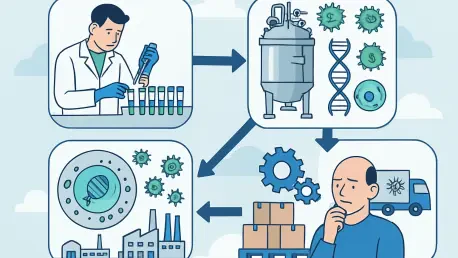

Adeno-associated virus (AAV) vectors are still the main tool for delivering genes into the body, but they are expensive to make. The usual method, called triple transient transfection in attached cell cultures, relies on costly plasmids, a lot of hands-on work, and does not scale well. As production increases, these problems get worse, leading to very high costs per dose, sometimes reaching hundreds of thousands of dollars when all materials and failure risks are included.
Advanced Therapy Medicinal Products cannot be scaled the same way biologics were. The core constraint is not steel and glass. It is biology, variability, and a regulatory environment that requires control, not just verification. Chemistry, Manufacturing, and Controls must demonstrate consistent performance of living systems at an industrial scale, across borders, while preserving patient-level variability that drives efficacy.
In global programs, complexity increases further due to divergent regulatory expectations and commercialization models. In the United States, FDA expectations around Chemistry, Manufacturing, and Controls documentation, potency assays, and comparability have steadily tightened as therapies move toward commercialization. The winners will not be those who simply add capacity. They will be those who redesign cost structures, industrialize batch-of-one manufacturing, professionalize analytics for gene editing, and establish comparability strategies that survive change.
The COGS Problem
A credible cost-of-goods strategy does three things.
Move to suspension bioreactors at commercial scale. Suspension cultures in stirred-tank systems increase volumetric productivity, improve oxygen and nutrient control, and simplify scale-up logic. The shift also unlocks single-use operations that reduce cleaning validation burdens.
Replace transient transfection with stable producer lines. Integrating the necessary genetic cassettes into the host cell limits batch-to-batch variability, reduces plasmid spend, and improves reproducibility. Upfront development effort is higher; the lifetime cost and regulatory simplicity often repay the investment.
Industrialize downstream purification. Chromatography-based full-to-empty separation, orthogonal impurity removal, and robust viral clearance steps reduce reliance on ultracentrifugation. The payoff shows up as higher recovery, safer impurity profiles, and faster cycle times that matter for cash flow.
Autologous Cell Therapy Without Heroics
Autologous therapies are operationally elegant in concept and messy in practice. Every batch is a unique patient. Every delay has clinical consequences. The technical goal is not classic scale-up. It is scale-out at high repeatability, with each batch of one treated as a serialized product moving through a consistent, closed system.
Directives for serious operators are emerging:
Commit to closed, single-use unit operations from leukopak to final formulation. This reduces the risk of contamination, limits operator variability, and makes cleaning validation tractable across sites.
Build an interoperable hardware stack. Cell selection, activation, genetic modification, expansion, and formulation equipment must work together through standard connectors and harmonized consumables. Point solutions create orphan steps and manual workarounds.
Engineer for decentralized deployment with centralized control. In the United States, vein-to-vein timelines, national patient distribution, and hospital network partnerships create pressure to position manufacturing capacity close to major treatment centers. A centralized control strategy, standardized master batch records, and a rigorous deviation taxonomy make this operationally viable.
Design chain-of-identity and chain-of-custody as software problems, not paperwork. Real-time device telemetry, electronic batch records, barcode or data matrix serialization, and exception workflows cut hours from disposition and reduce the risk of mix-ups.
The European Union’s revised Annex 1 to the GMP guidelines for sterile medicinal products, which came into effect on August 25, 2023, introduced significantly more stringent requirements for contamination control strategy, environmental monitoring, and aseptic operator qualification, with specific emphasis on implementing modern barrier technologies such as RABS and isolators to reduce contamination risk. This has direct implications for autologous cell therapy suites that rely on open steps or Grade A in Grade B operations.
There is no free lunch. Closed systems can be less flexible for atypical patients, and decentralized models demand consistent training and calibration. But the trade creates a path to predictable throughput and a defensible cost base.
The Analytical Burden For In Vivo Gene Editing
For in vivo editing, the drug product is not a single entity. It is a complex assembly of guide RNA, nuclease payload such as messenger RNA, and a delivery vehicle such as a lipid nanoparticle. Regulators are not only asking whether the vial is clean. They are asking whether the editor behaves as intended within the body and elsewhere.
This has direct operational consequences. Analytical strategy becomes a primary driver of development timelines, batch release speed, and regulatory risk. Programs that underestimate this burden often create downstream delays in comparability, tech transfer, and approval.
A modern strategy for in vivo editing includes the following:
Component-level release and characterization. Analytical methods that quantify identity, purity, and integrity for each component are mandatory. For lipid nanoparticles, this includes size distribution, polydispersity, encapsulation efficiency, and surface charge.
Fit-for-purpose potency. Mechanistic, cell-based potency that correlates with on-target editing at the relevant locus is the gold standard. Sponsors that rely on generic transfection readouts without locus specificity face questions about clinical relevance.
Off-target assessment with orthogonal methods. It is not enough to run a single next-generation sequencing assay. Validated methods that triangulate off-target risk, combined with bioinformatics pipelines that meet data integrity expectations, are fast becoming table stakes. The emphasis is on sensitivity and method lifecycle management, not only discovery.
Biodistribution and immunogenicity. Quantitative polymerase chain reaction and immunoassays track where the editor goes and how long it stays in the body. Assays that measure pre-existing and induced immunity to the editor components are also critical for safety.
The International Council for Harmonisation’s adoption of the ICH Q14 guideline on Analytical Procedure Development and the revised ICH Q2(R2) guideline on Validation of Analytical Procedures in November 2023, which came into effect in mid-2024, reshaped expectations by requiring sponsors to demonstrate method robustness, manage risk through the method lifecycle, and document control strategies that survive scale-up and tech transfer
Analytics are often the hidden driver of the schedule. Sample stability across sites, shipping constraints, and Qualified Person oversight can add weeks if not engineered early. Designing assays for speed and precision is not a luxury. It is a business requirement.
Comparability And Tech Transfer In Global ATMP Programs
The cruel irony of Advanced Therapy Medicinal Products is that the most valuable process innovations often arrive late. Stable producer lines mature. Closed-system hardware ships. Better assays appear. Changing anything after pivotal data generation invites scrutiny of comparability.That scrutiny then meets the realities of multi-site manufacturing and partnerships with contract development and manufacturing organizations. It also faces regulatory oversight from both the FDA and European authorities.
A robust comparability plan does the following.
Defines the control strategy in system terms. Instead of a long list of tests, it articulates the critical quality attributes, the link from process parameters to those attributes, and the acceptance criteria that reflect clinical understanding. This allows focused evidence rather than a full analytical reboot when changes occur.
Uses statistically disciplined, risk-based studies. Changes that affect cell phenotype, vector structure, or editor function warrant further investigation. Not every tubing set change does. Prioritization is essential for timeline control.
Anticipates site expansion. Method transfer packages, reference materials, and bridging studies are assembled early. A playbook that specifies what the receiving site must demonstrate for the Qualified Person to certify batches keeps variation in check.
Documents raw material strategy. Animal-origin-free media, traceable suppliers, and release testing for plasmids and critical reagents reduce uncertainty. Defining secondary sources for single-use components and pre-qualifying them with small-scale comparability prevents avoidable batch holds.
Regulators are increasingly evaluating frameworks for decentralized manufacturing of advanced therapies. In the United States, discussions around point-of-care manufacturing and distributed production models are emerging alongside similar conversations in Europe. Any workable model will require centralized quality oversight, harmonized quality management systems, and strong digital traceability.
Digital CMC
Manufacturing systems cannot carry this load without a digital backbone. Paper batch records, email-driven deviations, and spreadsheets slow batch release, increase deviation risk, and complicate GMP compliance. A modern stack reduces time to Qualified Person disposition and strengthens regulatory defensibility.
Manufacturing execution and electronic batch records. These drive consistent work instructions, capture device telemetry, enforce holds and verifications, and create audit-ready batch records that support GMP inspections and faster release decisions.
Laboratory information management, data pipelines, and method lifecycle documentation. Analytical methods require structured metadata, validated bioinformatics where applicable, and traceable version control aligned with regulatory expectations (e.g., ICH Q14/Q2).
Quality management and release analytics. Deviations, change control, and complaints sit in a single system with strong role-based access control. Release decisions are supported by integrated data, not manual reconciliation, improving speed and consistency.
Serialization and chain-of-identity. Serialized, patient-specific identifiers travel with the product from collection through manufacturing to infusion. Systems that reconcile identity at every handoff are critical for both patient safety and regulatory compliance.
Across these domains, the most valuable upgrades are architectural. They enable faster batch release, stronger compliance, and scalable comparability across sites, not just incremental efficiency gains.
Conclusion
So, the goal is not to scale Advanced Therapy Medicinal Products simply larger. It is to manage their biological variability at commercial scale without compromising therapeutic effectiveness. In the United States, where FDA oversight, cGMP compliance, and multi-site logistics intersect with the realities of these products, the difference between a program that succeeds and one that stalls often comes down to Chemistry, Manufacturing, and Controls decisions made well in advance.
Cost reform for adeno-associated virus, automation for autologous cell therapy, analytics that prove precision in vivo, and comparability that survives change are not separate projects. Each supports the others. Closed systems reduce contamination risk and drive consistent analytics. Reliable analytics enable confident comparability decisions. Strong comparability allows process improvements without triggering regulatory setbacks. Process improvements reduce cost and increase throughput.
This system works only when designed end-to-end. Optimizing individual components in isolation creates new bottlenecks elsewhere. None of this guarantees a smooth path. Biology will surprise. Hardware will fail. Regulations will evolve. Programs that succeed are those that eliminate self-inflicted complexity, surface risk early, and build evidence that travels. This is how scalable variability looks in practice and how Advanced Therapy Medicinal Products can move from promise to routine care across the world.