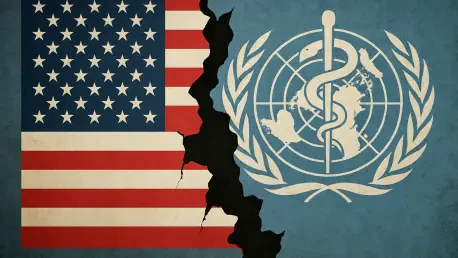

The once-unbreakable bond between the United States and the World Health Organization has officially been severed, sending shockwaves through the global public health infrastructure and raising urgent questions about the future of international cooperation in an era of resurgent nationalism. This roundup examines the multifaceted crisis unfolding in the wake of America’s departure, bringing together perspectives from policymakers, legal scholars, and the international health community to understand the rationale, repercussions, and potential paths forward.
A Global Health Alliance Fractured Setting the Stage
The finalization of the U.S. withdrawal from the World Health Organization this January marks the culmination of a year-long process initiated by a contentious executive order from President Trump on his very first day in office. This move dismantles a partnership that has been a cornerstone of global health security for decades. The United States was not merely a member; it was the organization’s primary architect and most significant financial supporter, making its departure a seismic event that challenges the WHO’s very existence.
Severing ties with the world’s principal public health body is a decision with far-reaching consequences. This analysis will navigate the complex terrain of this historic schism, starting with the administration’s official justifications for the split. It will then explore the ensuing legal and financial turmoil, document the unified global backlash against the decision, and detail the crippling operational impact that is now forcing the WHO into an unprecedented state of austerity.
The Anatomy of a Schism Rationale Repercussions and Resistance
From Ripped Off to Reality Unpacking the White House Rationale
The Trump administration’s justification for the withdrawal centers on a narrative of betrayal and financial inequity, encapsulated by the president’s assertion that the “World Health ripped us off.” Officially, the State Department has argued that systemic WHO failures in managing and sharing critical information led to catastrophic outcomes that cost the United States trillions of dollars. From this perspective, the U.S. is not abandoning its responsibilities but rather holding a dysfunctional organization accountable for its alleged shortcomings.
This rationale is also used to address the country’s outstanding financial obligations. The White House contends that its historical over-contributions and the economic damage attributed to the WHO’s failures effectively absolve it from paying the $260 million in dues owed for 2024 and 2025. This stance reframes the non-payment not as a default but as a justifiable financial correction, a position that stands in stark contrast to the legal and treaty obligations that typically govern membership in international bodies.
The 260 Million Question Navigating a Legally Contested Exit
The administration’s refusal to settle its accounts has become the core legal challenge to the withdrawal. Under U.S. law, exiting the WHO requires both a one-year notice and the full payment of any outstanding financial commitments. While the executive order satisfied the notice period, the unpaid dues place the legality of the move in a contentious gray area, raising questions about compliance with the nation’s own statutes.
Legal experts have characterized the action as a “clear violation of U.S. law,” although many question whether any practical consequences will ever be levied against the administration for its decision. The more significant concern is the institutional precedent this sets. By withdrawing from a major international treaty organization without meeting its financial obligations, the U.S. may inadvertently provide a blueprint for other nations to do the same, potentially destabilizing the funding models of numerous global bodies.
A Unilateral Move Meets a Wall of Global Opposition
The U.S. exit has been met with nearly unanimous condemnation from the international health community, which views the decision as a grave threat to both American and global well-being. A wide consensus among public health leaders is that the move represents a “shortsighted and misguided abandonment” of the collective responsibility to fight disease. This critique is rooted in the fundamental scientific understanding that pathogens do not respect national borders, making international cooperation an indispensable tool for protecting populations everywhere.
The WHO’s Director-General lamented the departure, framing it not as a political victory but as “a loss for the United States, and it’s a loss for the rest of the world.” This sentiment underscores the expert consensus that in a deeply interconnected world, an isolationist approach to public health is untenable. The withdrawal challenges the very premise of global health security by removing a key player from the collaborative network designed to prevent and respond to pandemics.
Inside the WHO an Organization Bracing for Financial Collapse
Internally, the U.S. departure has triggered a financial crisis of historic proportions. As the organization’s largest single donor, the United States provided over 18% of the total budget, and its absence has created a massive, immediate shortfall. The WHO is now in the midst of implementing drastic austerity measures simply to remain solvent, a process that is reshaping the agency from the top down.
These measures include halving the senior management team, significantly scaling back critical programs related to disease surveillance and response, and preparing to lay off a quarter of its global staff. The organization’s future now hinges on its ability to navigate this new reality. The upcoming executive board meeting in February is seen as a pivotal moment, where remaining member states must confront the budget crisis and chart a course for survival in a post-American era.
Navigating the Aftermath Key Takeaways and Strategic Imperatives
The core findings from this crisis are clear: the U.S. exit was a politically motivated decision with a legally questionable foundation that has provoked widespread condemnation and plunged the WHO into severe operational distress. This event serves as a stark warning about the fragility of international institutions when faced with the unilateral withdrawal of a keystone member.
For the WHO and its remaining partners, the strategic imperatives are urgent. The organization must aggressively pursue diversified funding sources to reduce its dependence on any single nation. Furthermore, this shock presents an opportunity to enact meaningful governance reforms aimed at building resilience and preventing future crises. Strengthening regional health alliances may also offer a crucial buffer against the volatility of global politics, ensuring that essential public health functions can continue even when global consensus falters.
A World Less Safe The Enduring Legacy of Americas Departure
The departure of the United States left a significant vacuum in global health leadership and weakened the world’s collective pandemic preparedness. The long-term implications for global disease surveillance, equitable vaccine distribution, and emergency response capabilities were profound, creating vulnerabilities that affected every nation.
Ultimately, this schism highlighted an inescapable truth about modern public health. Even after the formal break, the continued, albeit informal, sharing of critical information between U.S. agencies and the WHO underscored the fact that global health is an interconnected system. The crisis demonstrated that in the fight against infectious disease, no nation can truly or safely go it alone.