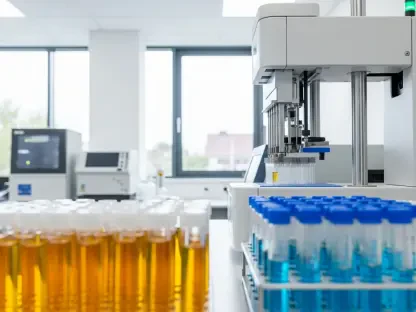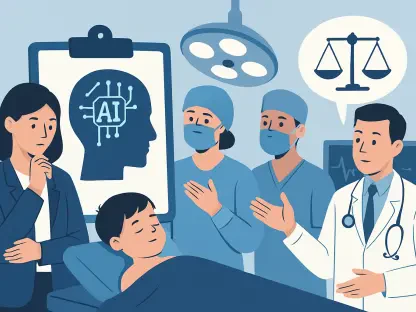

The biopharmaceutical industry is navigating a seismic shift where the intricate biology of disease is meeting the exponential power of computational intelligence, fundamentally altering how therapeutics are discovered, developed, and delivered. The integration of Artificial Intelligence (AI) represents a significant advancement, moving beyond conceptual frameworks to become a practical and indispensable force. This review will explore the evolution of AI applications, their key functions across the drug lifecycle, performance impacts, and the influence they have had on research, development, and manufacturing. The purpose of this review is to provide a thorough understanding of the technology, its current capabilities, and its potential future development.
The Ascent of AI in Biopharmaceutical Operations
The modern biopharma landscape is increasingly defined by the foundational role of AI. This ascent is propelled by a convergence of critical factors: the explosion in massive data availability from genomics, proteomics, and clinical records; a dramatic increase in computational power that makes complex algorithms feasible; and a strategic cultural shift within the industry. Companies are moving away from viewing AI as a peripheral tool and are instead embedding it into their core operational and research strategies.
This evolution marks a transition from isolated, proof-of-concept projects to systemic, enterprise-wide integration. Core principles like machine learning and predictive analytics are no longer novelties but are considered standard assets for tackling longstanding industry challenges. This strategic pivot is driven by top-down corporate mandates that recognize AI as a critical enabler of innovation and a source of significant competitive advantage in a rapidly changing market.
Core AI Capabilities and Applications
Revolutionizing Drug Discovery and Design
AI is being deployed to overcome some of the most formidable challenges in early-stage drug development, particularly in identifying and validating novel therapeutic targets. Sophisticated algorithms can now sift through immense biological datasets to pinpoint potential pathways for intervention with a speed and accuracy previously unattainable. This capability is proving transformative, allowing researchers to move beyond well-understood targets and explore new frontiers of medicine.
A groundbreaking application of this technology involves designing drugs for previously “undruggable” disordered proteins. A significant portion of the human proteome lacks the stable structure necessary for traditional drug binding, rendering many disease-related proteins inaccessible. To address this, AI-driven engines are being used to precisely design binding proteins, such as antibodies, that can effectively interact with these conformationally flexible targets. This approach is not merely an incremental improvement; it represents a fundamental paradigm shift that opens up entirely new therapeutic avenues for a wide range of diseases.
Transforming Clinical Trials and Real-World Evidence
The impact of AI extends deeply into clinical research and the utilization of real-world data (RWD). Predictive analytics are now instrumental in forecasting disease progression, which allows for more efficient trial design and early detection. Furthermore, AI models are optimizing patient recruitment and retention by identifying ideal candidates from vast electronic health records, a process that significantly reduces trial timelines and costs. This technology is also being applied to evaluate and predict risk factors at clinical study sites, enhancing oversight and compliance.
However, the efficacy of these AI applications hinges entirely on the quality of the underlying data. A high-quality data foundation—one that has been meticulously cleaned, labeled, and enriched—is a prerequisite for generating meaningful real-world evidence (RWE) and reliable predictive insights. Without this rigorously validated “foundation of facts,” AI models cannot accurately identify semantic patterns in regulatory observations or provide the robust compliance tools that organizations increasingly rely on.
Enhancing Manufacturing and Process Control
In the realm of biopharmaceutical manufacturing, AI is becoming a critical component for ensuring quality and efficiency. The technology is adept at identifying and continuously monitoring critical process parameters, which is especially valuable for new and complex production methods like continuous manufacturing. By analyzing real-time sensor data, AI can predict deviations before they occur, allowing for proactive adjustments that maintain product consistency and prevent costly batch failures.
This enhanced level of process understanding and control is also crucial for navigating an evolving regulatory landscape. As agencies like the FDA show greater flexibility toward innovation in manufacturing, AI provides the data-driven assurance needed to adopt advanced techniques confidently. By facilitating greater adherence to stringent standards, AI not only supports innovation in production but also reinforces the safety and efficacy of the final therapeutic product.
Latest Developments and Industry Trends
The maturation of AI in the biopharmaceutical sector is evident in its shift from siloed applications to systemic integration across the entire value chain. A key emerging trend is the development of highly sophisticated models that go beyond simple correlation to understand underlying causality. These advanced models can interpret complex biological mechanisms, providing deeper insights that guide research and development with greater precision. This technological leap is supported by a clear cultural change, as top-down corporate mandates now place AI at the very center of research programs and organizational strategy.
This trend toward advanced AI is coupled with significant innovations in therapeutic modalities. The development of next-generation treatments, including cell therapies, T-cell engagers, and antibody-drug conjugates (ADCs), is increasingly supported by AI. These complex biologics present unique challenges in design, testing, and manufacturing, and AI is proving to be an indispensable tool for optimizing their development and ensuring their efficacy and safety, thereby accelerating their path from the lab to patients.
Real-World Implementations and Strategic Impact
The integration of AI is profoundly shaping business strategy and operational efficiency across the biopharmaceutical industry. The technology’s influence is visible in major mergers and acquisitions, where companies are making strategic moves to vertically integrate and secure key assets in a technologically advancing market. For example, large-scale mergers are creating more comprehensive life sciences leaders in diagnostics and biologics, while targeted acquisitions secure promising drug candidates to hedge against future patent expiries. These decisions are increasingly informed by AI-driven market analysis and technological forecasting.
On an operational level, AI is being implemented in highly complex and regulated areas to drive improvements in compliance, safety, and efficiency. In aseptic processing for sterile injectables, automation and digitalization powered by AI help maintain sterile integrity during long manufacturing runs and manage sensitive molecules. Similarly, AI is used to optimize global supply chains, ensuring the integrity of the cold chain for temperature-sensitive biologics and managing the logistics of highly potent compounds, thereby mitigating risk and safeguarding patient safety.
Challenges and Regulatory Hurdles
Despite its rapid advancement, the widespread adoption and performance of AI in biopharma face primary challenges. The most critical technical hurdle is the need for a rigorously validated “foundation of facts.” AI models are only as reliable as the data they are trained on, and ensuring the accuracy, completeness, and integrity of massive datasets remains a significant undertaking for many organizations. Without a solid data foundation, there is a substantial risk of generating flawed insights, which can have serious consequences in a healthcare context.
Simultaneously, the industry must navigate an evolving regulatory landscape. New FDA guidance on production and process controls is designed to provide greater flexibility for emerging technologies like AI and continuous manufacturing, presenting a clear opportunity for innovators. However, the growing regulatory emphasis on the use of real-world evidence also introduces significant compliance challenges. Companies must develop robust frameworks for data governance and model validation to ensure that their AI-generated evidence meets the stringent standards required by regulatory authorities worldwide.
Future Outlook and Long-Term Potential
Looking forward, the trajectory of AI in the biopharmaceutical sector points toward even more transformative breakthroughs. One of the most promising areas is the acceleration of personalized medicine, where AI can analyze an individual’s unique genetic makeup and lifestyle factors to predict their response to different treatments. This capability has the potential to usher in an era of hyper-targeted therapies that are more effective and have fewer side effects, fundamentally changing how complex diseases are managed.
The long-term impact on drug development timelines and costs is also expected to be substantial. By automating and optimizing processes from discovery to post-market surveillance, AI will continue to shorten the notoriously long and expensive journey of bringing a new drug to market. Furthermore, as the industry places a greater emphasis on sustainability, AI will contribute to broader goals like operational efficiency by optimizing energy consumption in facilities and reducing waste in manufacturing processes, aligning innovation with environmental responsibility.
Concluding Assessment
The integration of artificial intelligence has firmly established it as a foundational and transformative technology across the biopharmaceutical lifecycle. Its current state reflects a significant maturation from a conceptual tool to a practical asset that is actively driving progress in drug discovery, reshaping the execution of clinical trials, and enhancing the precision of manufacturing. The industry now leverages AI to unlock novel therapeutic targets, optimize patient outcomes, and ensure rigorous process control. This progress, however, is balanced against the persistent challenges of maintaining data integrity and navigating a complex and dynamic regulatory environment. Ultimately, AI stands as a critical and indispensable driver of future innovation, poised to redefine the boundaries of medical treatment and operational excellence in the years to come.